 Canada
 United States
 Bahamas
 Jamaica
 Trinidad & Tobago
 Antigua & Barbuda
 Barbados
 Anguilla
Shift Premium Payroll Software for Union Manufacturing

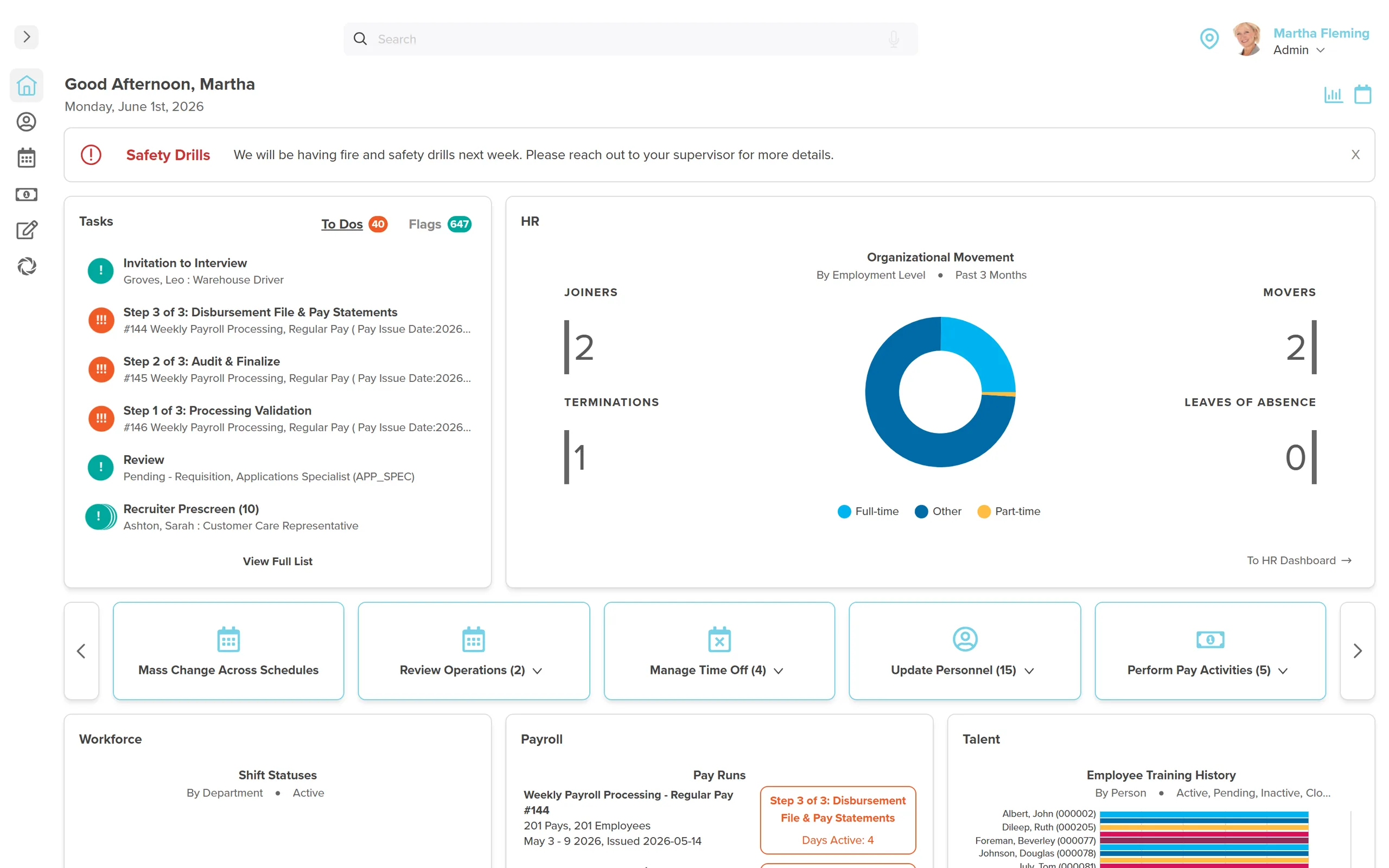
Get shift differentials wrong at a union shop and the grievance doesn't show up on payday. It shows up eight weeks later, backdated, with a steward standing behind it. Workzoom, like any HRIS actually built for manufacturing, ties union seniority, shift differentials, and multi-province withholding to the position itself, not to formulas buried in a spreadsheet. That's what lets a payroll manager running three union locals and a shutdown week's worth of ROEs close pay on one record, not five systems.
But most systems sold as "built for manufacturing" were designed around a single pay group and one overtime rule. Bolt three union locals onto that and the seams show fast.
Three union locals and four separate payrolls are not a headcount problem. They are proof the system was never built to put seniority and shift math on one employee record.
You didn't take this job to referee three seniority lists in Excel every pay period. You took it to pay people correctly and close the period without a fire drill. If that's not happening, the problem isn't your judgment. It's the tool stack under you.
- An HRIS needs multiple union seniority lists on file, not one company-wide list.
- Shift differentials and overtime must follow the governing wage-inclusion and rate rules.
- Federal and provincial overtime rules differ. Several provinces use daily and weekly thresholds, with exceptions and lawful averaging arrangements.
- ROE deadlines depend on filing method and pay frequency. CRA records are generally retained for six years from the end of the last relevant tax year, with exceptions.
- A shutdown week or seasonal layoff can generate hundreds of ROEs in a single pay period.
Why Manufacturing Payroll Breaks Generic HRIS Tools
Office payroll runs one calendar, one pay rate structure, one leave policy. A plant floor runs three or four. You've got a tool-and-die local, a production local, a maintenance local, each with its own grid and its own recall order. Layer on rotating shifts, temp labour that turns over constantly, and a shutdown week where only part of the plant is working. A system built for a single pay group falls over.
Manufacturing headcount also moves more than most sectors. Statistics Canada reported manufacturing payroll employment down 4,200 jobs in November 2025 alone, part of a cumulative decline of 38,100 jobs since January of that year. That kind of churn means more layoffs, more recalls, more ROE filings, not fewer. A system that treats headcount as static is guessing wrong from day one.
Union Seniority Lists Belong on the Position, Not the Person
Canadian labour law lets one employer run multiple union locals, each with its own bargaining agent and its own collective agreement. That's not an edge case. It's the plant floor. The seniority list, the recall order, the shift bidding rules: those attach to the bargaining unit and the job classification, not to the individual.
When an employee moves between departments, or gets recalled after a layoff, the system needs to carry the right seniority rules automatically. That means seniority, entitlements, and pay scale sit on the position and cascade the moment someone moves into it, not on a name in a spreadsheet tab that someone has to remember to update. Get this wrong once and it's not a typo. It's a grievance.
Shift Differential Payroll and the Overtime Order-of-Operations
Shift differential pay isn't set by federal law. It's set by the collective bargaining agreement, and every local can have a different number. That's fine on its own. The problem is sequencing.
Determine which shift differentials and earnings belong in the overtime rate under the applicable employment standard and collective agreement. Multiple rates do not produce one universal Canadian weighted-average rule. Test a worker with two job codes against the governing formula before configuring payroll.
Multi-Province Withholding, WCB Rates and the Quebec Layer
Determine withholding using CRA's province-of-employment rules, including employer-establishment and remote-work attachment rules. Determine employment-standards jurisdiction and workers' compensation separately. An employee's work address alone does not settle every rule. CPP and EI rates do not differ merely because one plant is in Ontario and another is in Alberta.
Quebec breaks the pattern entirely. Employees there run QPP instead of CPP, pay QPIP alongside a reduced EI rate, and get both a T4 and an RL-1, per Revenu Québec. If the plant is federally regulated, overtime follows the Canada Labour Code: time and a half after 8 hours a day or 40 hours a week, whichever pays more. Several provinces also use daily and weekly thresholds. Apply the employee's governing rule and any lawful exception or arrangement. A payroll manager who's only ever worked under one province's act is looking at a second rulebook the moment Quebec enters the mix, per the Quebec calculation alone.
ROE and T4 Volume When Layoffs and Temps Are Routine
Service Canada's ROE guide defines interruptions and deadlines. The usual interruption is seven consecutive calendar days with no work and no insurable earnings, subject to exceptions. The below-60% earnings trigger applies to specified reasons such as maternity, illness and caregiving, not every pay reduction. Electronic weekly, biweekly and semi-monthly ROEs are generally due five calendar days after the interruption pay period ends. Monthly and 13-period payrolls use the earlier of that date or 15 calendar days after the interruption begins. Paper ROEs follow their own timing rules. A scheduled shutdown does not by itself establish that every worker needs an ROE.
Insurable hours matter here too. They're the hours actually worked and paid, not the accumulated overtime rate. Twenty hours of overtime is twenty insurable hours, not thirty. A system that fudges that number is quietly wrong on every EI claim tied to it.
Now multiply that by a shutdown week or a seasonal layoff wave. A plant that runs three union payrolls and cycles temp labour can generate hundreds of ROEs and T4s in a single year, on top of everything else payroll already owes. We built a one-page worksheet with all the deadline math. It's at the end of this post if you just want the dates, no prose.
What Does an HRIS Evaluation Actually Need to Test Before You Buy?
Don't take a vendor's word for any of this. Bring your own data.
| What has to work | Single employee record | Spreadsheets + disconnected systems |
|---|---|---|
| Multiple union seniority lists | Tied to position, cascades on transfer | Manually tracked per local, per tab |
| Shift differential + overtime order | Blended rate calculated automatically | Manual formulas, easy to sequence wrong |
| Multi-province / Quebec tax | Calculated using the applicable payroll province and separate labour-standard rules | Separate exports per province |
| ROE volume during layoffs | Auto-generated from insurable hours on file | Rebuilt by hand from time sheets |
| Time capture at the clock | Exceptions flow to supervisor for review | CSV export, re-key into payroll |
Ask for the same test every time: one employee working two job codes across two union locals in a single week, in a shutdown period, and see the ROE it produces. If a vendor can't run that scenario in front of you, they can't run it for your plant either. That's the whole evaluation, in one test.
See how Workzoom handles union payroll, shift math, and ROE volume
Workzoom runs HR, workforce, and payroll on one employee record, starting at $4 per employee per month per suite, no setup fees, month-to-month. Bring your seniority lists and your last shutdown week's ROE batch.
Tell Us What You Need to SeeSee Workzoom in 30 minutes.
Real product, real questions, no slides. Starts at $4 per employee per month, CAD or USD, with $0 setup fees.
What readers ask after this post on shift premium payroll software.
Our clients
The teams that run their people on Workzoom.













Workzoom handles HR, payroll, workforce, and talent on one employee record. Book a 30-minute walkthrough.