 Canada
 United States
 Bahamas
 Jamaica
 Trinidad & Tobago
 Antigua & Barbuda
 Barbados
 Anguilla
Ministry of Labour Employment Standards: The Officer's Call

Ministry of Labour employment standards enforcement can require records for inspection. Ontario employers must keep records and make them readily available. Retention depends on the record: hours by day or week for three years after that day or week, wage-statement information for three years after it is given, employment-start information for three years after employment ends, and vacation records generally for five years after they are made.
- Ontario retention is record-specific: hours by day or week for three years after that day or week, wage-statement information for three years after provision, employment-start information for three years after employment ends, and vacation records generally for five years after creation.
- An Employment Standards Officer can inspect records that must be readily available. Follow any inspection request and obtain advice on its scope and timing.
- Missing records create practical proof and compliance risk. Keep the records required by the ESA and make them readily available for inspection.
- Retaliating against an employee who complains is a separate ESA violation, and the burden falls on the employer to disprove it.
- Ontario employees have up to two years to file a wage complaint, so old gaps in your records don't age out fast.
An Employment Standards complaint is not solved by having a policy on file. It is solved by producing the one record that proves the policy was followed on the specific day in question. Most HR managers assume the exposure is the policy itself. It isn't. The exposure is whatever gap sits between the policy and the proof.
You're not careless. You're not behind, either. Time, approvals, and pay usually live in three separate systems, built by people who never expected an outsider to ask for all three at once. Fix that before the call comes in, not after.
What Actually Puts an Officer at Your Door
Two things trigger contact. An employee files a complaint, which they can do while still employed or up to two years after the alleged violation, under the Employment Standards Act filing guide. Or the ministry runs a proactive employment standards investigation, often industry-targeted, with no complaint behind it at all.
Either way, the request looks the same: produce records for a defined period, for a defined employee or group, fast. Federally regulated employers, banks, telecom carriers, airlines, interprovincial trucking, answer to a different clock. The Canada Labour Code, Part III gives them six months instead of two years. Alberta lets employees file while still employed or within six months of their last day. Run payroll in more than one province and you're running more than one clock. Treating them as one is how gaps get missed. Our Canadian HR and payroll guide breaks down where each province's rules diverge.
The Records List, in the Order an Officer Asks For It
Section 15 of the ESA spells out exactly what has to exist, and the ministry's own recordkeeping guide is the checklist an Officer works from.
| Record | What it must show | Retention |
|---|---|---|
| Identification | Name, address, date employment began | 3 years after employment ends |
| Hours of work | Daily and weekly hours actually worked | 3 years after the relevant day or week |
| Wage statements | Required statement information | 3 years after the statement is given |
| Overtime | Hours and supporting pay information | Apply the hours and wage-statement retention clocks |
| Vacation | Entitlement earned, taken, and paid | Generally 5 years after the record is made |
Apply the start date and retention period for each record in the Ontario record-keeping guide. A longer internal archive can be sensible, but a vacation-record rule does not automatically become the legal retention rule for every hours or holiday-pay record.
How Fast Does an Employment Standards Officer Expect Records?
The Act doesn't give you thirty days. Records have to be "readily available," meaning producible without delay, in a format the Officer can read, even if a payroll provider or bookkeeper physically holds them. Handing records to a third party doesn't hand off the obligation. It's still yours to produce, promptly, on request.
Missing records can leave the employer unable to substantiate its account and create a separate record-keeping violation. The officer assesses the evidence available. Do not assume the employee's recollection automatically becomes a legally conclusive record.
The Reprisal Trap: How One Complaint Becomes Two
Here's where careful HR managers still get it wrong. An employee complains, and someone, a supervisor, a scheduler, occasionally HR itself, responds by cutting hours, changing a shift, or going cold in a performance conversation. Section 74 of the ESA's reprisal provisions prohibit exactly that: no penalizing an employee for asking about their rights, filing a complaint, or talking to an Officer. And the burden of proof runs backward on this one. Once a reprisal complaint lands, the employer has to prove the reprisal didn't happen. The employee doesn't have to prove that it did.
Ontario's ESA can provide reinstatement and compensation for loss in a reprisal matter. The outcome depends on the facts and decision-maker. Do not use a per-year compensation formula to estimate exposure.
Building a Recordkeeping System That Survives the Ask
The fix isn't a bigger binder. It's tying time, approvals, and policy acknowledgements to the pay period they belong to, so pulling three years of records for one employee is a five-minute query instead of an email chain to whoever left the company in 2023.
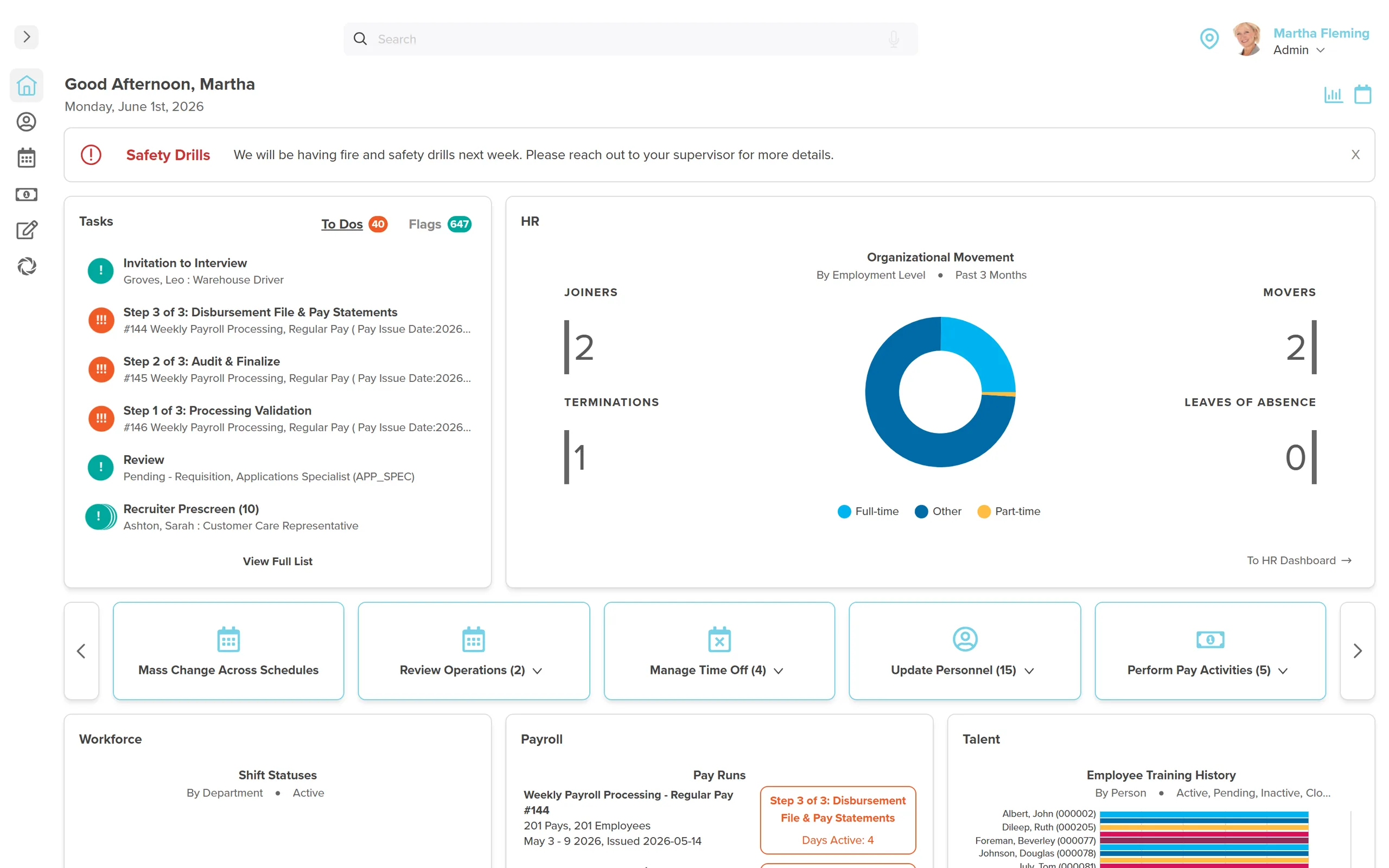
Workzoom keeps time punches, leave approvals, and policy sign-offs on one date-effective employee record instead of three systems reconciled by hand at month-end. When an Officer asks for hours worked on a specific week two years back, the answer is already sitting there, timestamped, with an audit trail showing who approved it and when. That's not a compliance project. That's just how a payroll and HR record should work in the first place. Our HR compliance checklist for Canada and our guide to Record of Employment deadlines cover the adjacent pieces worth auditing at the same time.
See how Workzoom keeps every pay period audit-ready
Workzoom ties time, approvals, and policy acknowledgements to one employee record, starting at $4 per employee per month per suite. No setup fees, no contracts, cancel anytime.
Book a 15-Minute Discovery CallSee Workzoom in 30 minutes.
Real product, real questions, no slides. Starts at $4 per employee per month, CAD or USD, with $0 setup fees.
What readers ask after this post on ministry of labour employment standards.
Our clients
The teams that run their people on Workzoom.













Workzoom handles HR, payroll, workforce, and talent on one employee record. Book a 30-minute walkthrough.