 Canada
 United States
 Bahamas
 Jamaica
 Trinidad & Tobago
 Antigua & Barbuda
 Barbados
 Anguilla
HRIS for Canadian Construction Companies (50–500 Employees)

A Canadian construction GC with 180 field workers and 22 office staff sat us down at the start of a discovery call and laid out their software stack. Time on paper, entered into a foreman-only spreadsheet, copy-pasted into a payroll service nightly. Certifications tracked in a separate spreadsheet that the safety lead updates whenever a ticket renewal comes back. WSIB classification kept in a third place because the bookkeeper never trusted what the payroll service was doing. Three systems, one human bridge between them. The bookkeeper had been there nineteen years and was about to retire.
An HRIS built for Canadian construction at the 50–500 employee range handles four things natively: certification tracking with expiry alerts, multi-site time capture, WSIB classification per worker, and CRA payroll remittance with T4 and ROE automation. One system, one employee record, no human bridge. The savings are real and they are not the licence fee.
- Most Canadian construction companies run three separate systems for time, certs, and payroll
- The hidden cost is the experienced bookkeeper or office manager who manually reconciles all three every week
- One HRIS with cert tracking + job-coded time + integrated payroll removes that reconciliation work
- Certified payroll for public-sector contracts requires job-coded time and classification rates the spreadsheet stack cannot easily produce
- Workzoom pricing: $4 to $16 per employee per month, no setup fees, month-to-month, implementation included
Here's the thing. Construction does not need a fancier spreadsheet stack. It needs the spreadsheet stack to go away. The bookkeeper who has been holding the operation together for nineteen years is going to retire, and the playbook does not retire with them.
The Three-Spreadsheet Problem
The standard Canadian construction back-office runs on three workbooks and a payroll service:
- Workbook 1. Crew timesheets. Paper from the field, entered by a foreman or coordinator, columns for job code, hours straight, hours overtime, equipment use.
- Workbook 2. Certifications. Worker name, ticket type, issuing body, issue date, expiry date, notes. Updated when someone remembers.
- Workbook 3. WSIB classification by worker, by job, sometimes by project. Maintained by the bookkeeper because the payroll service does not handle multi-class accurately.
- The bridge. A human exports Workbook 1, splits the hours by class using Workbook 3, runs an eye check against Workbook 2 to make sure nobody worked on a job their ticket does not cover, then uploads to the payroll service.
None of this is incompetence. It is a well-developed manual process that experienced operators built because no off-the-shelf system handled all three correctly. The pattern is consistent across Canadian construction companies in the 50 to 500 employee range. It works. It also depends on one person who has been doing it for a decade and is not coming with the company forever.
The pattern we have seen across Canadian construction prospects is the same three-workbook stack, in shop after shop.
That's not a software problem. That's a key-person-risk problem dressed up as a software stack. You're not the problem. The three-spreadsheet stack you were handed is.
Why Construction Is Different
Generic HRIS vendors built for office workforces miss four construction realities:
- Cert tracking is operationally binding. A worker whose first-aid ticket expired last week cannot be scheduled on certain sites. The HRIS has to surface the lapse before the schedule, not after the incident.
- Time capture is jobsite, not desk. Mobile clock-in, kiosk clock-in, or facial-recognition clock at the gate. Always with job code attached. Not a web app the worker logs into at 7am.
- WSIB classification varies per worker per job. A carpenter on a residential project may be class A. The same carpenter on a commercial high-rise the next month may be class B. The payroll system has to support that, not force one class per worker. (WSIB rate classifications)
- Certified payroll is a public-sector reality. Federal, provincial, and municipal contracts trigger prevailing wage and reporting requirements that the residential-only payroll services do not handle.
A US-built generalist HRIS will not handle these natively. A Canadian payroll service will handle the CRA piece and stop. A standalone safety platform will handle certs and stop. The construction operator stitches them together. Or they hire the nineteen-year bookkeeper, and pray she stays.
Where Construction HR Starts
The instinct on most HRIS implementations is to start with payroll because payroll is most visible. That instinct is wrong for construction.
The right first module to ship for a Canadian construction company is cert tracking plus time capture, run together. Reasoning:
- It produces a daily visible win. The foreman opens the schedule and sees crew certs at a glance. Day one of the new system.
- It de-risks the operation. A lapsed ticket cannot be scheduled into a job that requires it. The system blocks it.
- It generates the data that payroll needs next. Once time is job-coded by jurisdiction-aware class, payroll cutover is a configuration step, not a re-implementation.
Payroll goes live in the next phase, after the time data is flowing cleanly for two pay periods. That is the order. The reverse order, payroll-first then time and certs, is the order that stalls.
Certified Payroll Without the Headache
Construction operators with any meaningful public-sector exposure know what certified payroll involves. Job-coded time. Classification rates per worker per role. Prevailing wage compliance where it applies. Reporting in the format the contracting authority requires, monthly or per pay period.
The spreadsheet stack produces certified payroll reports through pure manual effort. Hours per pay period in the bookkeeper's time. Errors caught by the contracting authority cost more than the time saved.
The integrated HRIS approach: time is captured with job code at the source. WSIB class and prevailing wage class are properties of the job, not properties of the employee. Reports generate from a single query against a single audit log. The bookkeeper does not write the report. The bookkeeper reviews and approves.
What an Integrated HRIS Removes
The honest measure of an integrated HRIS for construction is not what it adds. It is what it removes. Run a quick subtraction on your current stack:
- The weekly time-card entry hour. Gone, because time captures itself at the jobsite.
- The monthly cert expiry chase. Gone, because the system alerts the safety lead 30 days before expiry.
- The bookkeeper's WSIB class spreadsheet. Gone, because class is a property of the job in the system.
- The reconciliation between the time spreadsheet and the payroll service every pay period. Gone, because there is one record.
- The "where is the ROE?" interruption every time a worker is laid off. Gone, because the ROE generates from the termination event automatically.
That's not a productivity gain. That's a job-description rewrite for the office manager. The work that used to fill the week is now done by the system. The office manager spends the week on planning, hiring coordination, and the things that grow the business.
The Honest Part
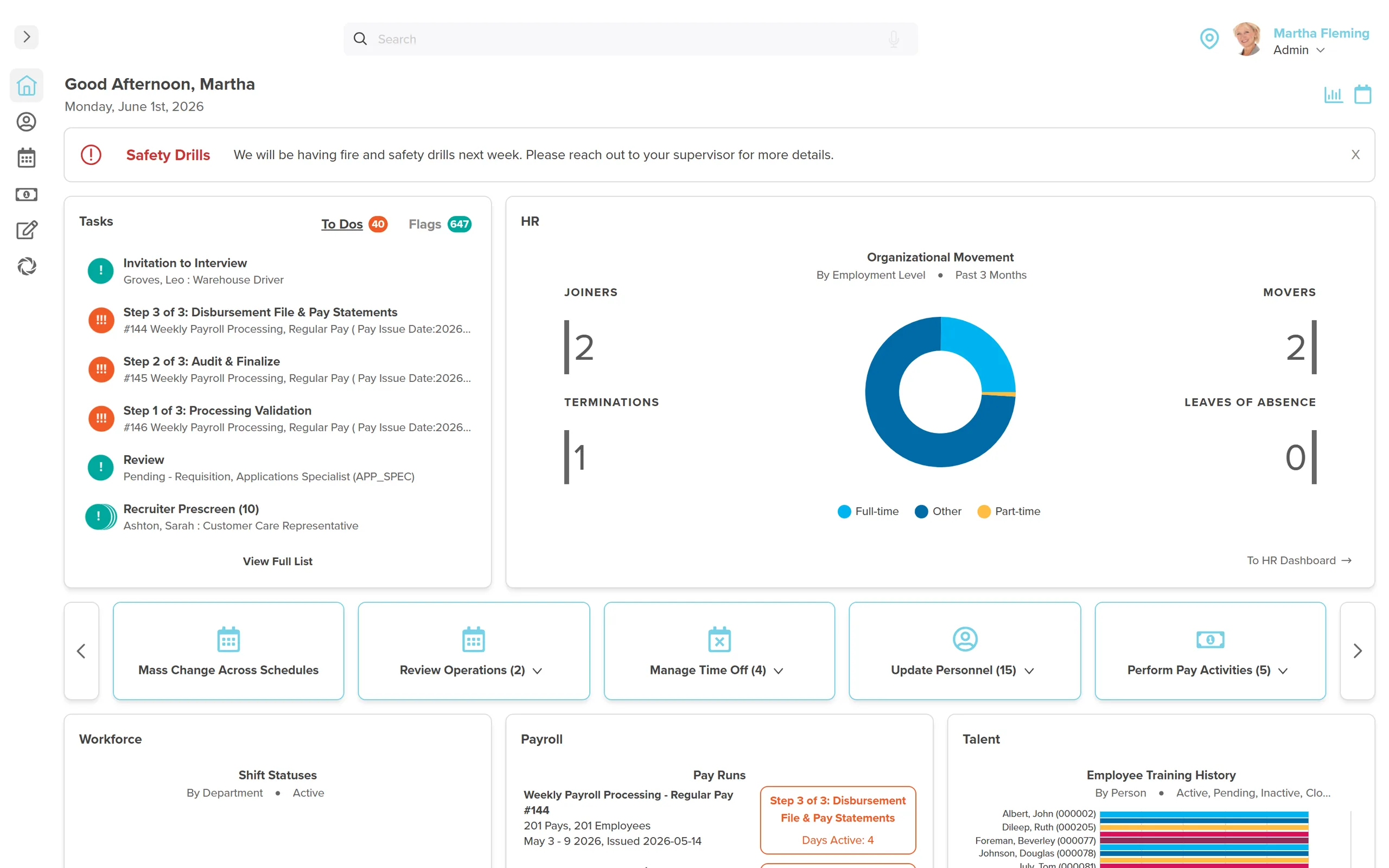
Workzoom is a twenty-five year old platform. HR, Payroll, Workforce, Talent, plus country-specific compliance. There are menus. There is a learning curve. We feel it every time we demo to a construction operator whose last system promised "easy" and was anything but.
What we have is a model that aligns with the operator's reality. No setup fees, no implementation fees, no multi-year contracts. Pricing starts at $4 per employee per month, and the model points us toward getting the time and cert modules running in 30 days, not toward billing for nine months of discovery. That difference matters more than any feature in the product sheet.
What to Ask in Discovery
Five questions to put to any HRIS vendor pitching a Canadian construction company:
- Show me cert tracking flagging a lapsed ticket at scheduling time. Live, not a slide.
- Show me a worker clocking in by jobsite from a mobile device. Live.
- How do you handle a worker who is class A on this job and class B on the next?
- What does a certified payroll report look like for a federal contract? Show the export.
- What does the first 30 days look like for our company, with named project manager and named modules?
The right HRIS for a 50-500 EE Canadian construction company replaces the experienced bookkeeper's playbook with a system that does the same job and does not retire. Time and cert first, payroll second, every other module after that. Pick a vendor whose model gets you live, not one whose model bills you for not being live.
If your office manager is going to retire in the next three years and the operation runs on their head, this is the decision to make before then. What does year one without them look like?
Tell us your jobsite mix and ticket types. We will show you the time-and-cert configuration first.
No setup fees, no contracts, month-to-month. Implementation, data migration, training, and support included. Canadian construction is one of our active ICP segments at the 50 to 500 employee range.
Tell Us What You Need to SeeSee Workzoom in 30 minutes.
Real product, real questions, no slides. Starts at $4 per employee per month, CAD or USD, with $0 setup fees.
What readers ask after this post on HRIS canadian construction.
Our clients
The teams that run their people on Workzoom.













Workzoom handles HR, payroll, workforce, and talent on one employee record. Book a 30-minute walkthrough.