 Canada
 United States
 Bahamas
 Jamaica
 Trinidad & Tobago
 Antigua & Barbuda
 Barbados
 Anguilla
Small Business HR Software Canada: The Enterprise Sold Down

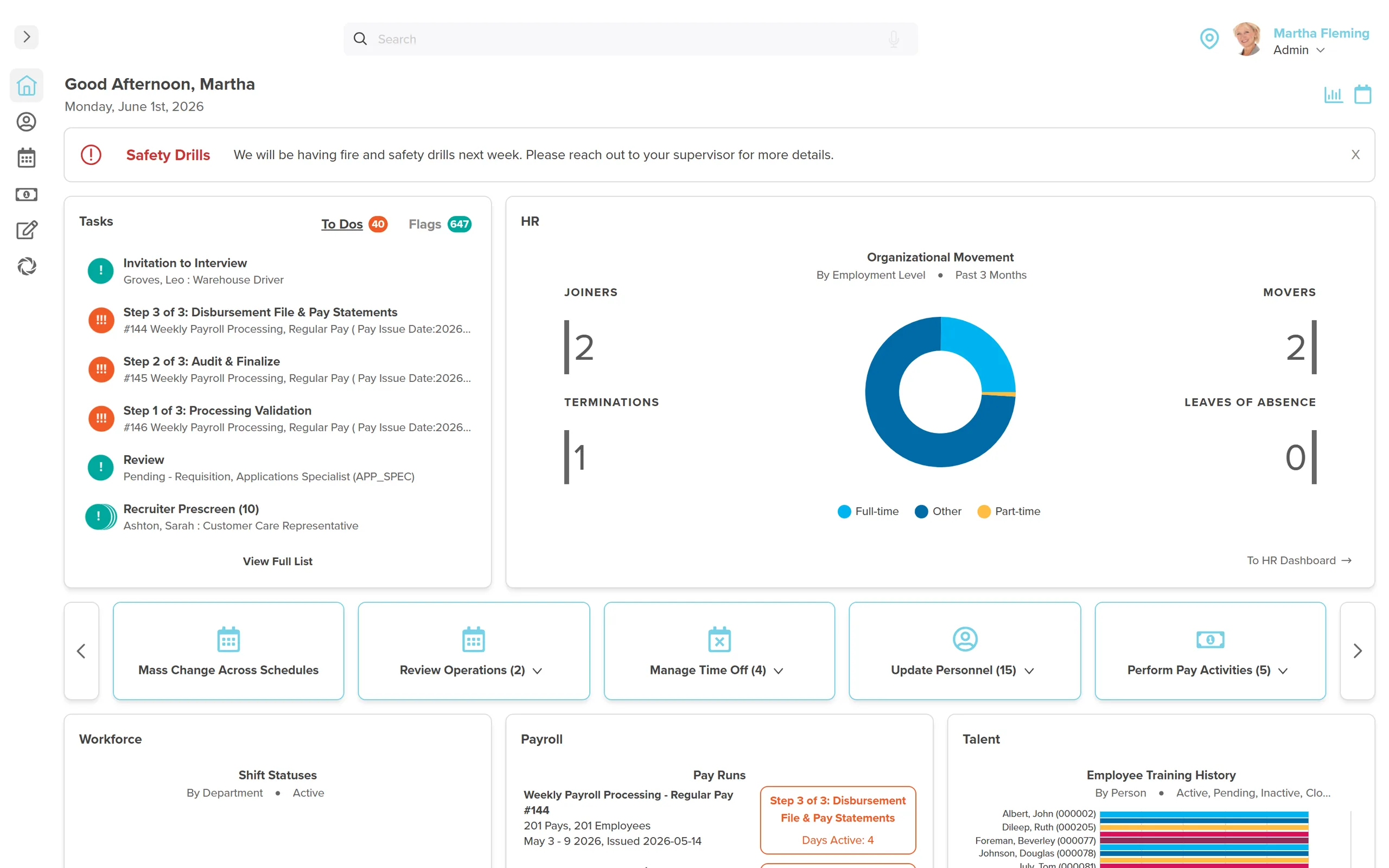
Most small businesses in Canada don't have an HR software problem. They have a wrong-size problem. They keep buying the enterprise version, platforms built for 5,000-person corporations, discounted down and sold to companies a tenth that size. The setup fees run five figures. Implementation drags across two quarters. Tier 2 support is an add-on, billed separately.
So they pay enterprise prices for software they will never grow into, then build manual workarounds for the half of it that doesn't fit. Not because software is a bad idea. Because nobody sold them the version built for their size.
You're not failing at HR. Your software was built for the wrong size of company.
The right HR software for a small business in Canada runs $4 to $16 per employee per month, charges no setup fee, and goes live in weeks instead of quarters. It handles Canadian payroll compliance natively, keeps employee records, scheduling, and payroll on one database, and scales from 50 to 500 employees without a dedicated implementation team. The rest of this is how to tell right-sized from enterprise sold down, and what to demand from any vendor before you sign.
- Most Canadian small businesses overpay for enterprise HR software engineered for companies far larger than them.
- Right-sized cloud HR software costs $4 to $16 per employee per month with no setup fees, no contracts, and Canadian payroll built in.
- For 2026, CPP contributions run at 5.95% on pensionable earnings up to the YMPE of $74,600, after the applicable basic exemption, with a CPP2 layer of 4% on earnings between $74,600 and $85,000. EI sits at 1.63% employee rate on maximum insurable earnings of $68,900. Both should be automated, not managed manually.
- The real cost of the wrong software isn't the licence fee. It's the manual workarounds it creates every pay period.
- Real Canadian employers at this size, from Alberta municipalities to Calgary seniors' housing, run HR and payroll on one record without an enterprise budget.
The Wrong-Size Trap
Most HR directors at growing Canadian companies shop for software the same way. They build a feature checklist, sit through the demos, and pick whatever ticks the most boxes. The checklist isn't the problem. Fit never makes the checklist.
A platform with 400 modules looks like future-proofing in a demo. Then you sign. For a 200-person company, the first year disappears into configuring features you will never use and opening tickets for problems the vendor's own implementation team created. A full year. Spent building things that never touch how your people actually work.
The pattern shows up everywhere. Companies running enterprise platforms at mid-market size still end up juggling three systems. Payroll in one. Time tracking in another. Employee records somewhere else again. Every pay period opens with a CSV export, and the week that export format quietly changes, payroll is late.
Spreadsheet payroll is a liability. Everyone knows that one. What nobody says out loud is that an enterprise platform spawning more manual workarounds than it kills is the same liability wearing a nicer login screen.
What Right-Sized HR Software Actually Does
Right-sized software for a 50 to 500 person Canadian company does four things, and does them without drama. Employee records connect to payroll, so data moves on its own instead of getting re-keyed by hand. Canadian compliance lives inside the engine instead of bolted on top. Employees can see their own information. Managers approve time and leave without phoning HR.
Northern Sunrise County, a municipal employer in Alberta with 90 to 140 employees, cut payroll processing time by 40% after switching to Workzoom. No clever AI feature did that. It came from killing the handoffs between disconnected systems, the exports and reconciliations and re-keyed numbers that quietly ate a day every cycle.
Here's the part the buying guides skip. Self-service matters more than buyers expect. Pay stub access, a leave balance someone can check themselves, a direct deposit change that doesn't start with an email to HR. Those are the interruptions that land on a desk every single week. Put the answers in employees' hands and admin time drops before a single workflow gets automated.
So when you weigh the best payroll software for small business in Canada, the real short list is short. Direct ROE1 filing to Service Canada. Automated CRA2 remittances. T43 generation. Multi-province support, if you run staff in more than one.
The Canadian Compliance Layer
Most HR platforms are American by birth. CPP4, EI5, RL-1s, ROEs, the entire Canadian statutory layer gets treated as a setting somebody switches on, not a decision the system was designed around. You feel the difference the first time a rate moves.
For 2026, the Canada Pension Plan employee contribution rate is 5.95% on pensionable earnings up to the Year's Maximum Pensionable Earnings of $74,600, after the applicable basic exemption, with a CPP26 layer of 4% on the band between the YMPE7 and $85,000. EI employee premiums sit at 1.63% on maximum insurable earnings of $68,900. None of that is a preference. It's statutory, and a missed CRA remittance deadline draws a penalty the same day. No grace period.
Software actually built for Canadian payroll carries this for you. ROEs generate on termination. T4s queue against the last day of February, with CRA weekend and holiday rollover rules. Provincial tax tables update without anyone on your team chasing CRA circulars. Software designed in the US and then "configured for Canada" rarely gets the detail right, and with payroll the detail is the whole job. The 2026 CPP2 ceiling and EI rate breakdown shows exactly where the gaps open up.
One Employee Record Changes Everything
Silvera for Seniors, a Calgary non-profit, runs 400 staff across 36 buildings. Before Workzoom, the HR team was buried in spreadsheets and disconnected tools that did not talk to each other, and schedule changes never flowed cleanly into payroll. "Before Workzoom, we were buried in spreadsheets and paperwork. Now our HR tasks are so much simpler. We're spending less time on admin and more time supporting our staff and residents," said HR Generalist Crystal Murray.
County of Renfrew, an Ontario municipal employer with roughly 900 employees, was cataloguing hundreds of resumes per job posting in Excel. After implementing Workzoom, the AI resume parsing tool filtered candidates automatically. HR Manager Greg Belmore put it plainly. "We wouldn't be able to hire the people that we do anymore with the same resources we already had." They onboarded 32 employees in a single pay period. Zero paper.
Neither of those is an enterprise story. Both are organizations doing what HR at a smaller company demands. Running the whole function without a 12-person department to throw at it.
No $20,000 setup fee. No six-month onboarding. The right HRIS platform for your size doesn't require enterprise infrastructure to get there.
Right-sized, in practice
That's the whole idea behind Workzoom. HR, Workforce, Payroll, and Talent on one employee record, starting at $4 per employee per month, with no implementation fees and no contracts. Built for 50 to 500, not sold down from enterprise.
Tell Us What You Need to SeeThe HRIS8 buyer questions checklist at the bottom of this post maps out exactly what to ask vendors before you commit. Pull it down if you're evaluating platforms now. Built specifically for Canadian small and mid-market buyers.
See Workzoom in 30 minutes.
Real product, real questions, no slides. Starts at $4 per employee per month, CAD or USD, with $0 setup fees.
What readers ask after this post on HR software for small business Canada.
Our clients
The teams that run their people on Workzoom.













Workzoom handles HR, payroll, workforce, and talent on one employee record. Book a 30-minute walkthrough.