 Canada
 United States
 Bahamas
 Jamaica
 Trinidad & Tobago
 Antigua & Barbuda
 Barbados
 Anguilla
Best HR Software for Canadian Healthcare: Union & Non-Union

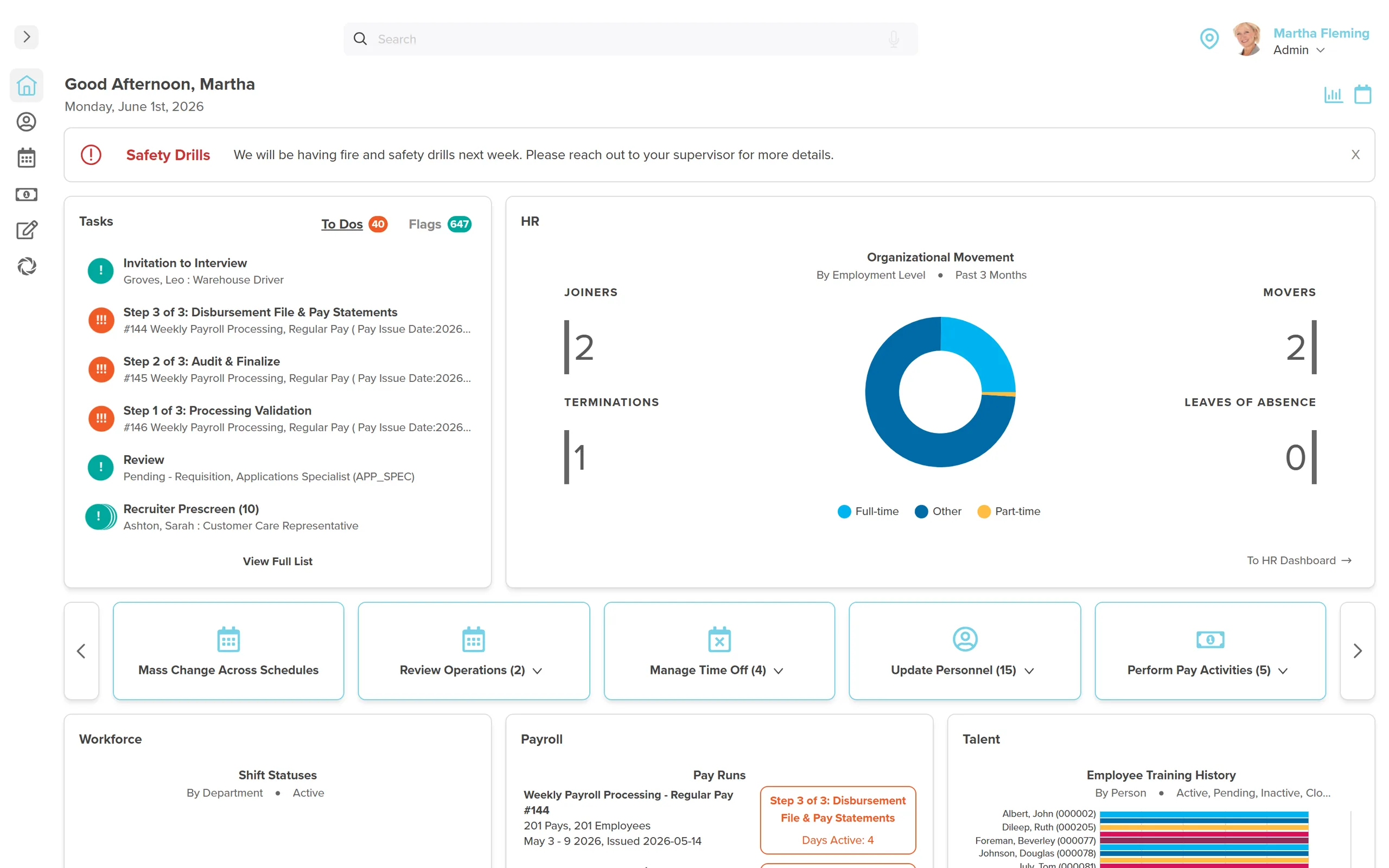
The best HR software for healthcare in Canada handles 24/7 multi-site scheduling, union and non-union staff under separate collective agreements, certification expiry tracking, and provincial employment standards from one connected system. Canadian healthcare employers need a platform where shift hours flow directly into payroll, certification alerts fire automatically, and a staff record change updates everywhere without a manual sync step. Starting at $4 per employee per month, Workzoom handles all of this without setup fees or annual contracts.
Most Canadian healthcare employers don't choose the wrong HR software. They choose software built for a company that doesn't run nights, weekends, or a roster split across two collective agreements.
It's not a feature problem. It's a fit problem. The best HR software for Canadian healthcare treats 24/7 multi-site scheduling, union and non-union staff on the same roster, certification expiry, and provincial employment standards as the default case, not an edge case bolted on later.
A platform built for a 200-person tech company handles none of that well. A platform configured precisely for healthcare handles all of it from a single system. You got into healthcare administration to keep care running, not to chase shift hours between three systems. When payroll breaks, it's the software asking you to do its reconciliation by hand.
- Canadian healthcare HR software must handle 24/7 multi-site scheduling, union and non-union staff on the same roster, and certification expiry tracking as core features
- Generic HR platforms underestimate provincial overtime variation, shift premium calculation, and the certification-to-scheduling link that healthcare employers need
- Workzoom's Workforce module handles scheduling, time capture, and leave alongside HR records and payroll, all on one employee record
- Pricing is $4 per employee per month per suite, no setup fees and no annual contracts. A 400-person operation using HR, Workforce, and Payroll pays $4,800 per month
HR software that understands the Canadian healthcare workforce
Workzoom is trusted by senior care and healthcare organizations across Canada. Scheduling, payroll compliance, and HR management in one platform. $4/employee/month, no setup fees.
Book a Healthcare DemoUnique HR Challenges for Canadian Healthcare Employers
Healthcare is one of the most operationally complex industries for HR and payroll, and the Canadian healthcare context adds additional layers that generic platforms regularly underestimate.
24/7 Scheduling Across Multiple Sites
Whether you operate a single long-term care facility or a network of care homes across a region, scheduling is never simple. Staff work days, evenings, nights, and weekends. Call-ins happen. Overtime rules apply differently for part-time and full-time staff. Shift premiums for evenings and weekends need to feed into payroll automatically, not get manually adjusted every pay period.
For healthcare employers running scheduling in a separate system from payroll, the data sync between those systems is an ongoing source of payroll errors. Hours that get logged in one system need to be verified, imported, and reconciled in another. Every manual step is an opportunity for error.
Certification and Credential Tracking
In healthcare, credentials are not just a human resources concern. An RN whose nursing license has lapsed, a PSW whose first aid certification expired last month, or an administrator whose mandatory training is overdue can create both regulatory exposure and liability risk.
HR software that tracks certification expiries and triggers renewal reminders is not a nice-to-have for healthcare employers. It is a compliance requirement embedded in their staffing obligations.
High Turnover and Seasonal Staffing Needs
Canadian healthcare employers face persistent staffing challenges. High turnover in frontline care roles means onboarding is not an occasional process; it is a continuous one. Organizations that rely on manual onboarding workflows for new hires spend significant administrative time on paperwork that could be automated. That time comes directly out of the hours available for resident or patient care.
Union and Non-Union Workforce Management
Many Canadian healthcare employers have both unionized and non-unionized staff, sometimes in the same facility. Different collective agreements apply different scheduling rules, different overtime calculations, and different leave entitlements. An HR system that handles only one employment type well creates compliance gaps for the other. The same principle drives CUPE payroll for municipalities: each agreement is its own pay group with its own grid and rules.
The healthcare HR challenge is not just payroll. It is the integration of scheduling, certification tracking, and compliance documentation that creates the real operational complexity. Software that handles one well but requires manual processes for the others solves part of the problem and creates new ones.
What the Best HR Software for Healthcare in Canada Delivers
When evaluating HR software for a Canadian healthcare organization, these capabilities separate platforms that work from platforms that technically function but require constant manual intervention:
Integrated scheduling and payroll. Shift hours flow directly into payroll without a manual import step. Shift premiums, overtime, and stat holiday pay calculate automatically based on the schedule data.
Certification and training tracking with automated alerts. Certification expiry dates are stored against each employee profile. Reminders trigger 60, 30, and 7 days before expiry to the employee's manager and HR team.
Multi-site management. For organizations with multiple care facilities or departments, the HR system must support separate cost centres, separate scheduling configurations, and aggregated reporting across all sites.
Provincial employment standards compliance. Healthcare employers in Ontario, Alberta, British Columbia, and other provinces each operate under different employment standards for overtime, stat holidays, and hours of work. The platform should handle provincial variations automatically, not require manual configuration updates when legislative changes occur.
Onboarding automation for high-volume hiring. New hire paperwork, orientation scheduling, and credential collection should be automated so that onboarding a new PSW or care aide takes hours, not days.
Workzoom for Multi-Site Healthcare and Public-Sector Employers
County of Renfrew is a public-sector employer in Ontario with approximately 900 employees. Their workforce shares the healthcare operational profile: mixed employment types, continuous onboarding demand, and a compliance burden that requires accurate payroll at scale without a large administrative staff.
County of Renfrew onboarded 32 employees in a three-month period using Workzoom's onboarding automation. The documentation, orientation scheduling, and payroll setup for all 32 ran without proportional increases in HR staff time. That pace matters for healthcare-adjacent employers where high-volume onboarding is a recurring reality, not an exceptional quarter. For County of Renfrew, the move to zero paper was the operational shift.
For US healthcare comparison, Mid-Wilshire Health Care Center (approximately 100 employees, California) completed full HR and payroll automation in one month after implementation. The pattern is consistent across sectors: the trigger to switch is the week the multi-site spreadsheet produces a payroll error nobody can trace.
This is the pattern we see across our Canadian client base: the breaking point is never a missing feature. It is the number of places a single shift has to be re-keyed before it becomes a paycheque. One shift, one record, one payday.
The real mechanism behind that consistency is not an "integrated system" claim. It is the person-position data model. Each employee holds a position in the org structure. That position carries its collective agreement, overtime rules, certification requirements, and cost centre. When the position updates, payroll, scheduling, and reporting all reflect it. Role-based security determines who can see and approve each change. There is no manual sync step because the data lives in one structure, not three tools talking to each other.
Canadian Healthcare Payroll Compliance
Healthcare payroll is not more complicated than other industries in terms of the base statutory deductions (CPP, EI, income tax). The complexity comes from the interaction between shift patterns, overtime rules, and stat holiday pay calculations.
Provincial Overtime Rules
Overtime thresholds and calculation methods vary by province and, in some cases, by employment category within a province. In Alberta, overtime is triggered at 8 hours per day or 44 hours per week. In Ontario, overtime is 44 hours per week. In British Columbia, it is 8 hours per day or 40 per week, with double-time after 12 hours in a day.
For a healthcare employer with staff working 12-hour shifts, the difference between provinces is significant. A platform that handles Alberta overtime correctly may not handle BC daily overtime without reconfiguration.
Stat Holiday Pay for Irregular Schedules
Statutory holiday pay for employees who work irregular or shift-based schedules requires a calculation based on average earnings over a reference period. This is not a flat dollar amount. It needs the payroll system to look back at earnings history to calculate the correct stat pay entitlement for each affected employee.
Shift Premiums and Differentials
Evening and weekend shift premiums are a standard feature of healthcare employment. These differentials need to be configured in the payroll system, linked to scheduling data, and applied automatically. Manual entry of shift premiums every pay period is a recurring source of payroll errors and employee complaints.
The payroll compliance challenge in healthcare is not the base statutory deductions. It is the interaction between scheduling, shift types, overtime rules, and stat holiday calculations. A payroll system that does not connect to scheduling data is doing half the job.
Integrated vs Specialized Healthcare HR Software
Healthcare employers evaluating HR software sometimes consider platforms purpose-built for healthcare, such as scheduling systems designed specifically for care settings. These platforms often handle scheduling well but have limited HR and payroll functionality, requiring integration with a separate payroll system.
The alternative is an all-in-one platform that handles HR, scheduling, and payroll from a single system. The trade-off: slightly less healthcare-specific specialization in scheduling, significantly less complexity in data management and integration.
For most Canadian healthcare employers in the 50 to 1,000 employee range, the all-in-one approach reduces operational complexity more than specialized scheduling tools add value. The key question is whether the all-in-one platform's scheduling capabilities are genuinely capable for shift-based healthcare operations, not just adequate.
Implementation for Healthcare Environments
Healthcare organizations cannot afford payroll disruptions. Implementation planning must account for this reality.
Workzoom's healthcare implementations follow a phased approach:
Phase 1: HR module go-live (employee records, onboarding, document management). No disruption to payroll during this phase.
Phase 2: Workforce module (scheduling, time and attendance). Parallel with existing scheduling system until validation is complete.
Phase 3: Payroll go-live with parallel run. Two pay periods running simultaneously to validate output before cutting over fully.
Most healthcare implementations of this type take six to twelve weeks from start to full go-live. The phased approach ensures that care operations are never dependent on a system that has not yet been validated. For a deeper view of what a clean cutover looks like, see our HR software implementation guide.
If you are still reconciling shift hours by hand every pay period, you're not the problem. The tool you were handed was built for a workplace that closes at five, and you have been covering for it ever since. The right system stops asking you to do that work.
Provincial overtime rules vary significantly. The Ontario Employment Standards Act guide on public holidays is the canonical reference for Ontario healthcare employers calculating stat holiday pay for shift-based staff.
Frequently Asked Questions
Does Workzoom support multi-site healthcare organizations?
Yes. Each site can have its own scheduling configuration, cost centre, and department structure, while HR and payroll reporting aggregates across all locations. The person-position data model means a staff change at one site updates the full employee record automatically, without a manual sync between a scheduling tool and a separate payroll system.
Can Workzoom handle both union and non-union staff?
Yes. Workzoom supports multiple employment categories within a single organization, including different overtime rules, leave entitlements, and payroll configurations for union and non-union staff. Collective agreement terms that affect scheduling and pay calculations can be configured per employment group.
Does Workzoom track staff certifications and send expiry reminders?
Yes. Workzoom's HR module includes a credential and certification tracking feature where expiry dates are stored against each employee profile. Automated reminders can be configured to alert the employee, their manager, or the HR team at configurable intervals before the expiry date.
What is the pricing for healthcare organizations?
$4 per employee per month per suite (HR, Workforce, Payroll, Talent). No setup fees, no annual contracts. A 400-person organization using HR, Workforce, and Payroll pays $4,800 per month. Most healthcare organizations find the ROI case clear once they calculate the current cost of manual scheduling, payroll corrections, and credential tracking.
How do we book a healthcare-specific demo?
Use the link above to book a 30-minute call. Tell us your employee count, the number of sites you operate, and the specific pain points you are trying to solve.
How does Workzoom calculate stat holiday pay for shift-based healthcare staff?
Stat holiday pay for employees on irregular schedules is based on average earnings over a reference period, not a flat amount. Workzoom's payroll engine looks back at earnings history to calculate the correct stat entitlement per employee, pulling directly from scheduling data. No manual entry needed each pay period. For Ontario-specific rules, see the Ontario ESA public holidays guide.
See Workzoom in 30 minutes.
Real product, real questions, no slides. Starts at $4 per employee per month, CAD or USD, with $0 setup fees.
What readers ask after this post on best HR software healthcare Canada.
Our clients
The teams that run their people on Workzoom.













Workzoom handles HR, payroll, workforce, and talent on one employee record. Book a 30-minute walkthrough.