 Canada
 United States
 Bahamas
 Jamaica
 Trinidad & Tobago
 Antigua & Barbuda
 Barbados
 Anguilla
HR Software for Nonprofits in Canada: Split Pay, Four Grants

Type “hr software for nonprofits” into Google and you get a dozen near-identical lists of the same six small-business HR platforms with a nonprofit discount pasted onto the pricing table. That's not the question you're actually trying to answer.
The best hr software for nonprofits does two things a relabeled small-business platform can't: it keeps volunteer records completely separate from payroll data, and it splits one employee's pay across multiple grants and cost centres without a manual spreadsheet in between. Everything else, including the sticker price, is secondary.
Stop comparing HR software by price per employee. Compare it by whether volunteers can ever touch payroll data.
You're not failing. Your spreadsheet is failing you, and so is the payroll vendor who told you it could “probably” handle a grant split with a manual workaround.
- Nonprofit-fit HR software keeps volunteer records structurally separate from payroll, not just hidden in the same table.
- Grant-funded organizations need pay split across cost centres by percentage, automatically, not re-allocated by hand after the fact.
- Confirm the CRA reporting treatment for volunteer honoraria, contractors, and other non-employee payments. Do not use one payment threshold as a universal rule.
- Ontario job-posting compensation rules apply to covered employers with 25 or more Ontario employees, subject to posting and compensation exceptions.
- Financial-review requirements depend on the incorporating statute, soliciting status, revenue and applicable member decisions. Confirm the organization's requirements with its accountant.
Why “Best HR Software for Nonprofits” Searches Miss the Real Question
Most of what ranks for this search is a repackaged version of the best HR software in Canada for 2026, with “nonprofit” dropped into the intro and a line about discounts added near the bottom. That's fine if you run a ten-person office with one funder and no volunteers. It's useless if you're the person reconciling volunteer hours against payroll and re-splitting a coordinator's salary across three grant codes before a funder report is due.
The real evaluation question isn't “what's the cheapest per-employee rate.” It's “does this system draw a hard line between the people we pay and the people who show up for free.” A platform can look great in a demo and still be wrong for you if it can't answer that one.
The Three Things Generic HR Software Gets Wrong for Nonprofits
Small-business HR platforms are built for one payroll, one cost centre, and one kind of person on the roster: the employee. Nonprofits run three populations at once, sometimes four counting board members, on a funding structure that resets every fiscal year. Here's where the mismatch shows up.
| Requirement | Nonprofit-fit platform | Relabeled small-business tool |
|---|---|---|
| Volunteer records | Separate module, no payroll fields, no employee login | Same employee record, no real separation |
| Pay allocation | Splits one salary across grants and programs by percentage | One cost centre per employee, manual workaround |
| Budget cycle | Built for annual funding renewals and headcount that shrinks with a grant | Assumes stable revenue and stable headcount |
Volunteer vs Employee: Why Mixing Them in One System Creates a Compliance Problem
Volunteer honoraria and other service payments need a classification and reporting review. CRA fees-for-service guidance addresses T4A reporting, but a single payment threshold does not classify every honorarium, expense reimbursement or employment payment. Determine the payment's nature and recipient status before choosing the slip.
Ontario courts have gone further: work that looks like an employee's job doesn't become volunteer work just because you called it that on a spreadsheet tab. A true volunteer has to be uncoerced and unpaid. Blur that line inside one HR system, with volunteer hours and employee hours sitting in the same table, and someone eventually gets paid wrong or classified wrong.
Board members who volunteer their time sit in the same murky zone: unpaid, but carrying fiduciary duty. Most systems have no idea what to do with a person like that. But back to the payroll line. Nonprofits withhold and remit CPP, EI, and income tax exactly like any other employer, with no exemption for mission-driven work, so routing a payment through the wrong record type isn't just messy. It's a remittance error.
The structural test worth running on any shortlist: can a volunteer's profile exist in the system without a bank account field, a tax form, or a login that touches payroll. If the vendor's answer is “you'd just leave those fields blank,” that's not separation. That's a spreadsheet with better formatting.
Grant-Funded Payroll and Cost-Centre Allocation, Explained for Non-Accountants
Say your program coordinator's salary is funded 60% by a provincial grant, 25% by a private foundation, and 15% by unrestricted donations. Every pay run, that split has to show up correctly in three places: the pay stub, the general ledger, and eventually the funder report.
Accounting standards for nonprofits require restricted and unrestricted funds to be tracked separately, and grantors routinely require their own cost-allocation report showing exactly how their dollars covered staff time. A payroll vendor that processes one flat rate per employee can't do this. Neither can a small-business HR tool that treats “department” as a single dropdown field. You end up exporting to Excel, splitting the numbers by hand, and hoping nobody moved programs mid-quarter. That's not a workflow. It's a liability.
For federally incorporated organizations, Corporations Canada explains financial-review requirements by soliciting status and revenue. Provincial incorporation and funding agreements can impose different requirements. Confirm the applicable audit or review engagement with the accountant, and retain the grant-by-grant payroll allocation that supports it.
How Do You Evaluate HR Software When Your Budget Depends on Next Year's Funding?
Forget the feature checklist for a minute. Ask four questions instead.
- Can a volunteer record exist with zero payroll fields attached, permanently, not as a workaround?
- Can one employee's pay split across more than one grant or program automatically, every pay run, with no manual reconciliation after?
- Does the reporting pull compensation data straight into a format your board or auditor can use for Schedule 3 of the T3010, without a rebuild?
- What happens to your monthly bill if headcount drops because a grant ended? Month-to-month billing matters more here than almost anywhere else.
If a vendor can't answer the second question live, using your organization's actual numbers, that's your answer. Not the sales deck. The demo.
Two Ontario regimes belong in the evaluation. Confirm coverage under the Pay Equity Act, which covers public-sector employers and private-sector employers meeting its employee threshold. For public job postings, covered employers with 25 or more Ontario employees must provide the required compensation information, subject to exceptions including compensation over $200,000. Where a range is required, its spread cannot exceed $50,000.
We've built these four questions, plus the CRA reporting checks above, into a one-page worksheet. Pull it down at the end of this post if you'd rather hand it to your ED than re-explain it.
When Your Nonprofit Needs a Sector-Specific Platform Instead
Not every nonprofit needs this. A five-person advocacy office with one funder and no volunteers can run on almost anything, spreadsheet included, for another year or two. But once you're managing multiple grants, a volunteer roster, and a board asking for cleaner reporting, the relabeled small-business tool stops helping and starts being the thing you fight.
Some nonprofits sit closer to a specific sector than “nonprofit” as a category. A children's aid society's compliance load looks more like HR software for children's aid societies in Canada than a generic nonprofit list. An organization funded through a municipal-style position budget has more in common with how municipalities track authorized versus filled positions than with a small-business platform. The category label on the vendor's homepage matters less than whether the underlying structure matches your workforce.
Whatever you land on, weigh it against how the workforce side handles scheduling and time capture too, since payroll splits usually start with hours worked, not just a salary rate.
See whether a platform actually keeps volunteers and payroll separate
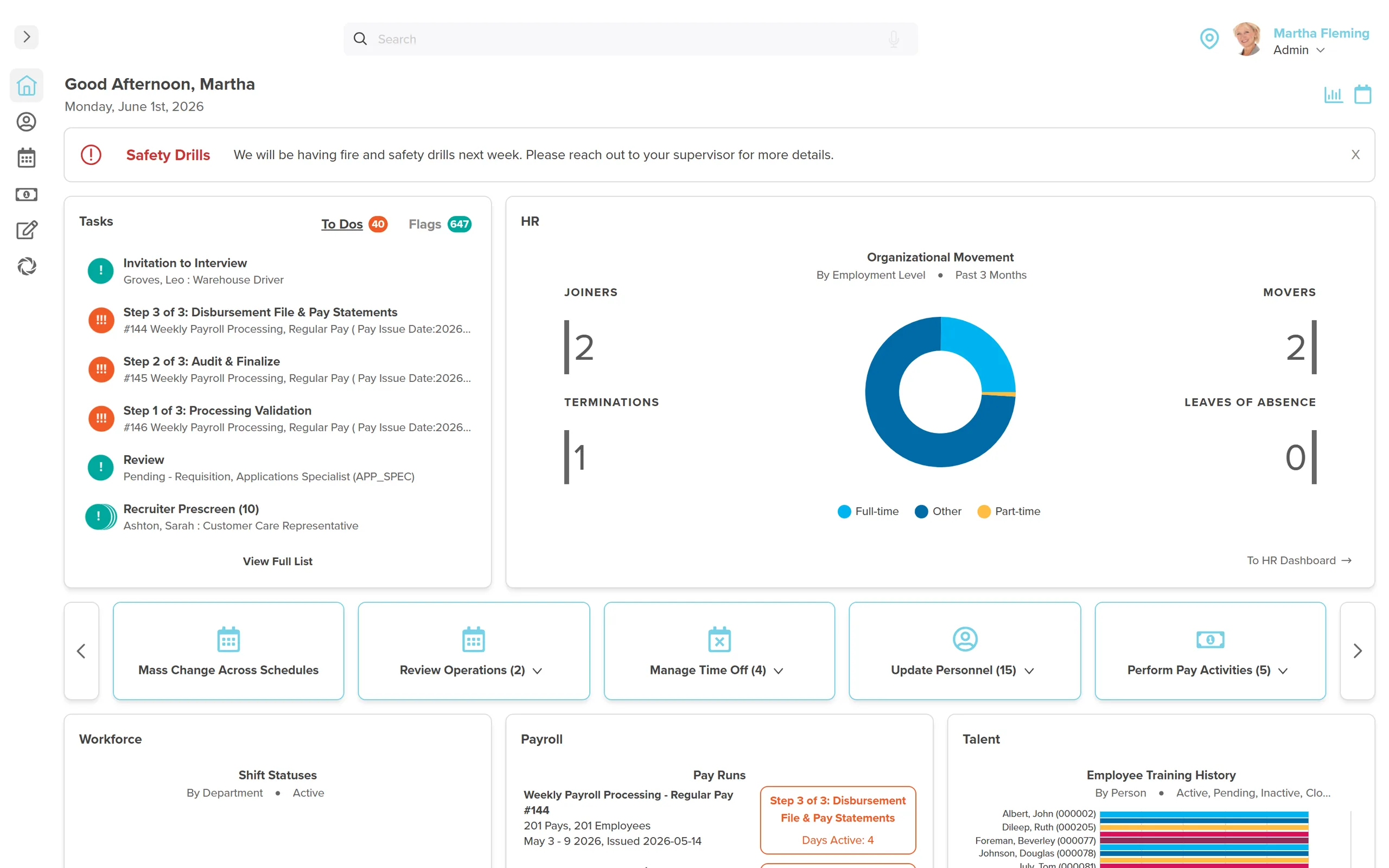
Workzoom runs HR, payroll, and workforce management on one employee record, starting at $4 per employee per month per suite, with a 5% nonprofit discount stackable with annual billing. No setup fees, no contracts, month-to-month.
Book a 15-Minute Discovery CallSee Workzoom in 30 minutes.
Real product, real questions, no slides. Starts at $4 per employee per month, CAD or USD, with $0 setup fees.
What readers ask after this post on HR software for nonprofits.
Our clients
The teams that run their people on Workzoom.













Workzoom handles HR, payroll, workforce, and talent on one employee record. Book a 30-minute walkthrough.