 Canada
 United States
 Bahamas
 Jamaica
 Trinidad & Tobago
 Antigua & Barbuda
 Barbados
 Anguilla
Workforce
Biometric clocking, in plain English.
Book a Workzoom walkthrough → 25+ years of HR and payroll production. Live in Canada, the US, and the Bahamas.
Biometric clocking authenticates employee identity at punch time using a fingerprint or facial scan.
Read the full answer
It prevents buddy punching, the practice of one worker clocking in for another, because the punch is tied to a physical characteristic that cannot be handed off. Workzoom supports fingerprint and facial recognition with kiosk and mobile capture across multiple locations.
How Biometric clocking works.
Biometric clocking identifies an employee by a physical characteristic, most often a fingerprint or face, instead of a card or PIN. Modern systems store a mathematical template rather than an image, and the template cannot be reversed into the original biometric. Because the data is biometric, collection and retention are regulated in many jurisdictions and generally require notice and explicit consent before enrollment.
Where Biometric clocking goes wrong.
- Deploying biometric capture without the written notice and consent a jurisdiction requires is the most serious exposure, since biometric data carries its own legal category separate from other HR records.
- A second is retaining templates after employment ends where the applicable rule requires deletion, which turns a compliant system into a liability the longer it runs.
- A third is having no fallback method for employees whose biometric will not enroll, which leaves them unable to clock in at all.
- 2000 Running payroll since Workzoom has run Canadian payroll for 25+ years.
- Canadian data residency AWS Canada (ca-central-1). Canadian customer data stays in Canada.
- SOC 2-aligned controls Encrypted at rest, role-based access, immutable audit logs.
- Trusted in production County of Renfrew, Silvera for Seniors, and Cable Bahamas. Built for 50 to 5,000 employees.
In the product
How Biometric clocking runs on Workzoom.
Biometric clocking is part of the Workzoom Workforce Suite. Workzoom runs HR, workforce, and talent on a single employee record across ten countries: Canada, the United States, the Bahamas, Jamaica, Trinidad and Tobago, Barbados, Antigua and Barbuda, Anguilla, the Cayman Islands, and the United Kingdom. Full gross-to-net payroll runs live in Canada, the United States, and the Bahamas. Pricing starts at $4 per employee per suite per month.
Questions about Biometric clocking
More on Biometric clocking
Playbooks and teardowns from teams putting it into production.

Best HR Software for Barbados Employers (2026 Guide)
The best HR software for Barbados compliance: Employment Rights Act, NIS, BRA payroll. See how Workzoom handles the Caribbean workforce.
Read article →
Shift Premium Payroll Software for Union Manufacturing
Shift premium payroll software must test seniority and differentials before a grievance surfaces eight weeks late.
Read article →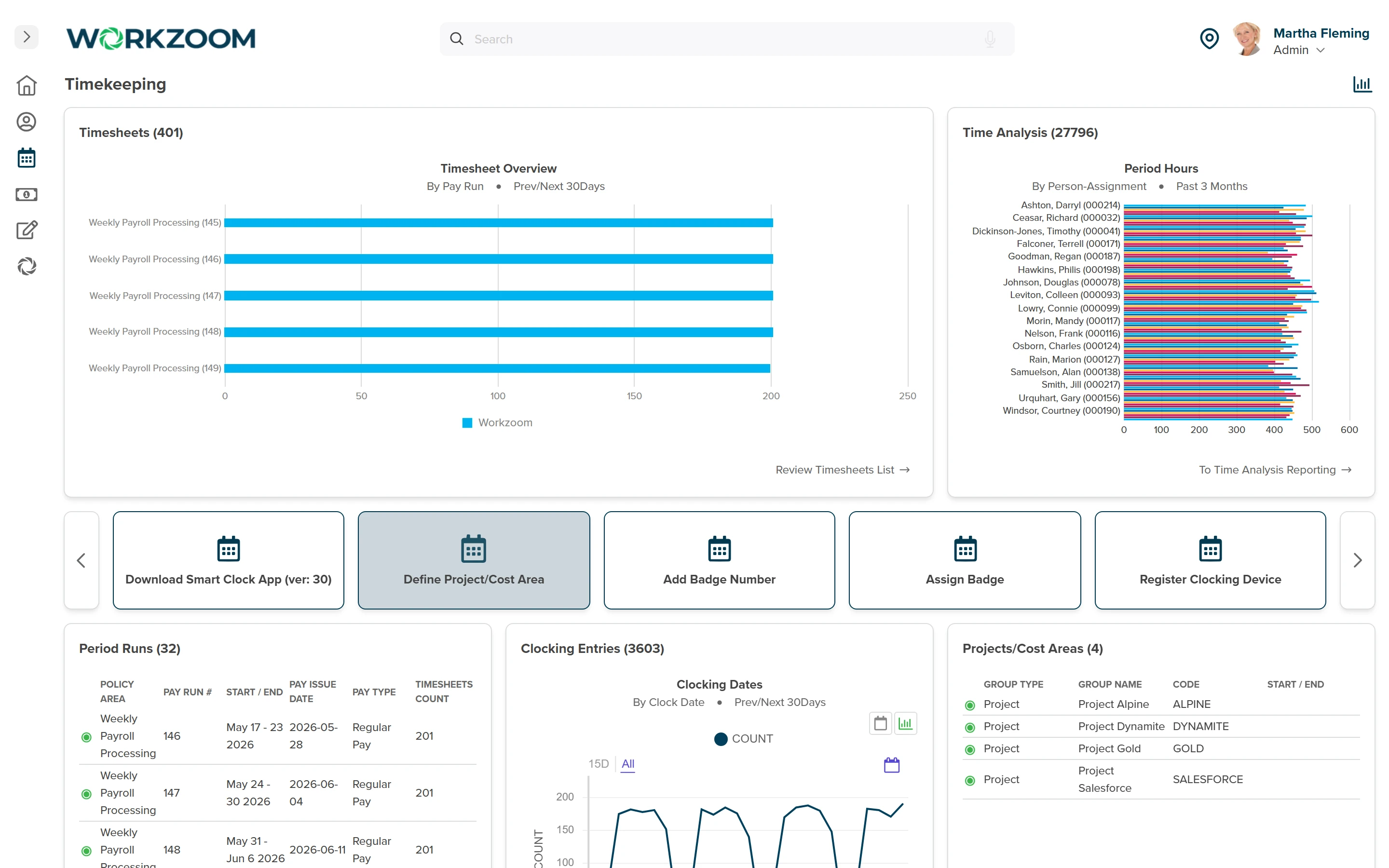
Time Tracking Software in Canada: Compare Payroll Fit
Compare time tracking software in Canada by payroll fit, approvals, overtime rules and total cost. Use practical demo tests before choosing...
Read article →
Canadian Payroll 2026: What Changes When Quebec Joins
Adding a Quebec employee to Canadian payroll changes the EI rate, remittance form and leave entitlement, and this guide names each shift.
Read article →Run HR, payroll, workforce, and talent on one platform.
$4 per employee per suite. 50 to 5,000 employees. Sprint-based, client-paced go-live.