 Canada
 United States
 Bahamas
 Jamaica
 Trinidad & Tobago
 Antigua & Barbuda
 Barbados
 Anguilla
HR Software Pricing in 2026: The Real Cost

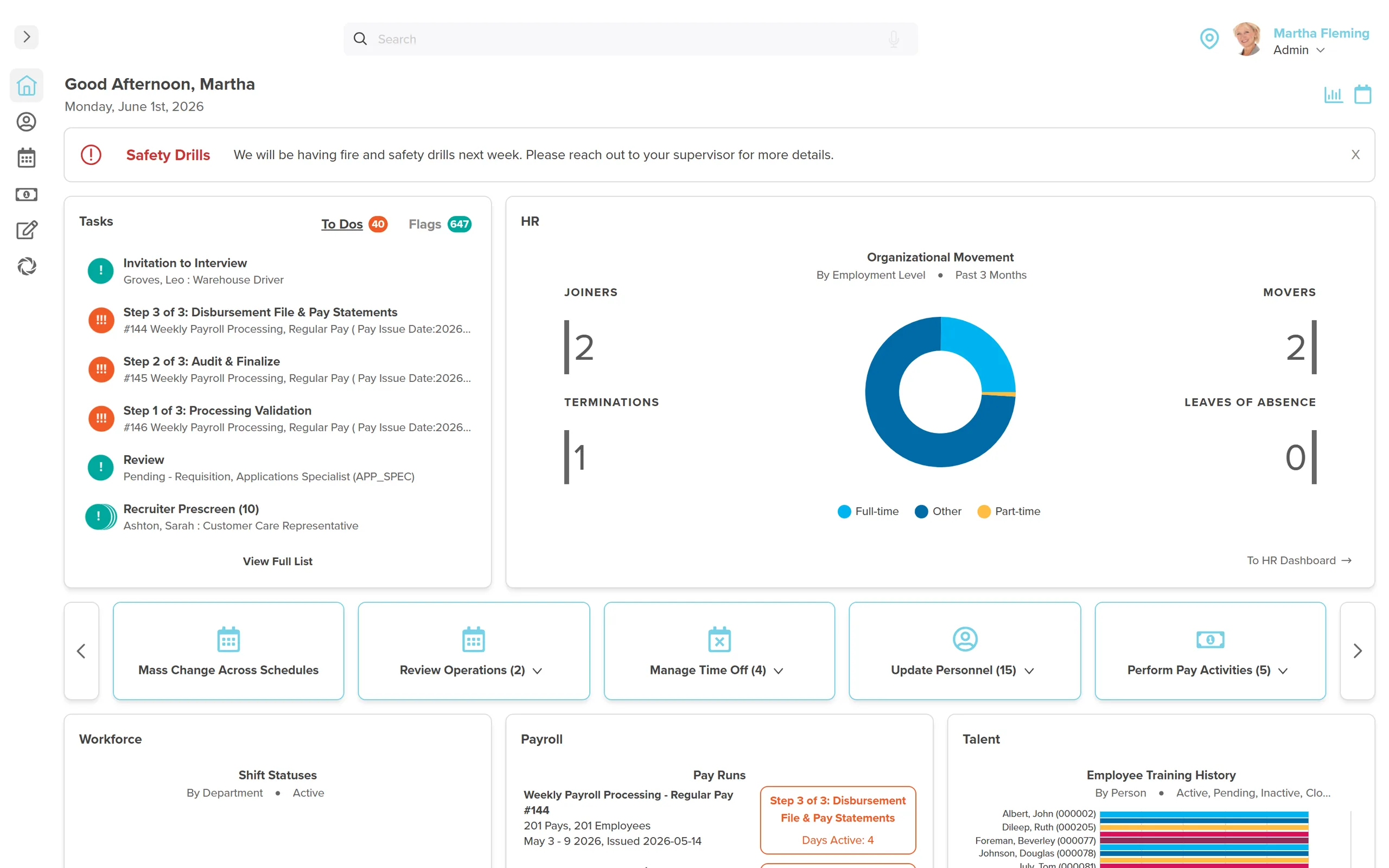
HR software pricing is the question Workzoom gets first in every demo: what does this cost us up front, and what does it cost over the years? The honest answer is the same rate, year on year. You start month to month, move to annual for 5% off whenever you're ready, and stay monthly until you're happy.
That kind of honesty is rarer than it should be.
Most HR software vendors won't answer that on a pricing page. You get a "Request a quote" button, a form, and a discovery call booked before anyone says a number out loud. Shortlist six platforms and you will fill out six of those forms, then line up six quotes that share no common shape. One is per employee. One is a tiered annual licence. One bundles implementation. One doesn't, and that line arrives two emails later. You set out to compare software. The software was never the hard part. The pricing was.
The way a vendor prices its software tells you more about the company than the demo does.
Workzoom publishes its pricing: $4 per employee per month per suite, up to $16 for the full platform, with no setup fee and no contract.1 Most HR software hides the number because the setup fee, the multi-year contract, and the per-integration charges are where the real cost lives. Published pricing is itself a feature, because it means the company is comfortable with what it charges.
- HR software pricing falls into three models: published per-employee, quote-only enterprise, and flat-rate small business. Only one lets you compare before you talk to sales.
- The sticker price is rarely the real price. Implementation, data migration, and training commonly add 10% to 50% of your annual subscription, and most vendors bill each integration separately.2
- First-year cost routinely runs well above the advertised subscription once implementation and internal time are counted.
- Workzoom publishes a flat $4 per employee per month per suite, with implementation, data migration, training, and support included, billed month-to-month.
- The fastest way to compare vendors is to stop comparing stickers and add up the multi-year total, year one through five.
Why is HR software pricing kept behind a quote?
Walk the pricing pages of the biggest names in this category and you will notice how few of them have a price on them. Workday does not publish per-employee pricing and routes every buyer to its sales team for a custom quote. Dayforce does not publish per-employee pricing. ADP pricing is not published and requires a direct sales conversation.3 This is the norm at the top of the market, not the exception.
There are honest reasons for some of it. Enterprise deployments genuinely vary, and a 6,000-person multinational does carry real configuration cost. But the quote wall does something else too. It stops you from comparing. When no two vendors show a number, the only way to line them up is to enter each one's sales process, and by then you are three calls deep and emotionally invested in a decision you cannot yet price.
So read the wall as information. A company that publishes its pricing has decided it does not need the call to defend the number. A company that hides it has decided the opposite. Neither is automatically wrong. But you should know which conversation you are walking into.
The Three Pricing Models, and What Each One Hides
Almost every HR platform prices one of three ways. Knowing which model you are looking at tells you where to go hunting for the cost that isn't on the page.
| Pricing model | Typical vendors | Sticker price | Setup fee | Contract |
|---|---|---|---|---|
| Published per-employee | Transparent platforms (Workzoom) | $4 to $16 per employee per month, published | None | Month-to-month |
| Flat-rate / per-seat SMB | BambooHR, Gusto | SMB-tier per-employee SaaS with published pricing pages | Varies; check vendor pricing page | Varies |
| Quote-only enterprise | Workday, Dayforce, ADP | Hidden, sales-quoted | Thousands to 100%+ of annual | Multi-year |
The published per-employee model is the easiest to reason about. You read the rate, multiply by headcount, and you have a number before you ever speak to anyone. The flat-rate small business model looks similar but usually firms up only after a quote, and the implementation line is separate. The quote-only enterprise model is where the sticker tells you the least, because the sticker is the smallest part of the bill.
There is a quieter cost to a price you have to negotiate: it depends on how well you negotiate. Two companies buy the same software in the same month and pay different numbers, and the one that pushed harder pays less. A published rate takes that off the table. Ours is the rate. You are not lying awake wondering whether there was 30% on the table you left there because someone else in the room argued better than you did.
The Setup Fee Is Where the Real Money Hides
Ask any HRIS1 buyer who has been through it twice. The licence is the part you negotiate. The implementation is the part that surprises you. In the demos we run, the per-employee rate is rarely the number that worries people. We've seen buyers blindsided by an implementation fee a previous vendor sprang on them after the signature, when the buyer no longer had negotiating room.
Scoped against the software itself, implementation, data migration, and training commonly add 10% to 50% of your annual subscription, enough to push the first-year bill close to double the monthly rate you were quoted.2 At the enterprise end it climbs higher still, with five-year cost of ownership routinely running past 100% of the licence. Then come the integrations. Connecting your new HR system to payroll, to a benefits carrier, to accounting is rarely free: many vendors bill each connection separately, or meter it per API call, and the charge rarely surfaces until after you have signed.2
None of this is dishonest, exactly. It is all in the contract somewhere. But it is structured so the number you see first is the number that makes you say yes, and the number you pay arrives in pieces after you have. That's not a pricing page. That's a funnel.
What "Included" Should Mean
There is a version of this where the price on the page is the price you pay. It is rarer than it should be, so it is worth describing plainly.
Workzoom prices at $4 per employee per month per suite. The HR suite is the foundation, and Workforce, Payroll, and Talent layer on at the same $4 each, up to $16 per employee per month for the full platform. A 100-person company running HR and Payroll pays $800 a month. There are monthly minimums between $400 and $700 depending on how many suites you run, so the smallest teams pay a floor rather than a per-seat rate that collapses to nothing.
You don't have to buy all four suites on day one. Most teams start with one or two, the ones they need first, and expand from there. The rate holds either way, year on year: you start month to month, move to annual for 5% off whenever you're ready, and stay monthly until you're happy.
What is not on a separate line: implementation, data migration, training, ongoing support with a named contact, and every product update. They are carried by the per-employee rate, not billed against it. The contract is month-to-month, with a 5% discount for annual billing and 10% for a three-year term if you want to lock a rate. The point is not that this is the cheapest sticker in the market. It is that the sticker is the whole story.
A setup fee is not a line item. It is a clue. When implementation and integration make up a large share of year one, the vendor is earning on the transition rather than the software. Price the whole first year, not the monthly rate, and the cheap option often changes.
How to Compare Apples to Apples
It's not the monthly rate that breaks the budget. It's everything stapled to it. So the buyers who get this right stop comparing monthly rates and start comparing totals. They run three numbers for each vendor, year one, year two, and the five-year total, then line those up side by side.
The three numbers each say something different. Year one carries the setup fee and the integration charges, so it is the year a no-setup vendor can look worse than it is and a quote-only one can look cheaper than it will be. Year two is the clean run rate, the number you live with. The five-year total is where contract structure shows its real shape, because a month-to-month rate and a discounted multi-year lock with a five-figure implementation rarely land where the monthly sticker suggested. Build each total the same way: the software fee for your real headcount, plus implementation, plus every integration charge, plus your own team's rollout time, the hours your staff lose to migration and training, which almost no quote mentions.
Run that exercise across a shortlist and two things happen. The quote-only platforms stop looking like premium and start looking like a longer bill. And the published-pricing option, the one you could price in thirty seconds, turns out to be the one you understood all along. If you want the deeper version of this comparison, our breakdown of what 250 employees cost in year one runs the numbers platform by platform, and the all-in-one ROI guide shows where the disconnected-system tax hides.
Where Workzoom Is Honest About Its Own Price
Workzoom is an all-in-one platform built since 2000. That depth is real, and so is the trade. There are menus. There is a learning curve. A team that wants four features and nothing else will see more product than it strictly needs on day one.
What it will not see is a setup invoice, a multi-year lock, or a number that changes between the website and the contract. For a 50 to 500 person company that has been burned once by an enterprise platform sold down with a five-figure implementation attached, that trade tends to be the easy one. You can read the rest of our thinking on the buying mistakes that cost the most before you talk to anyone.
Cable Bahamas made that trade. After moving to Workzoom, payroll processing dropped 70%, from five days to a day and a half, run by the same three-person team. That is what an honest price buys: less time lost, not more product to learn.
See the number first
Workzoom's pricing is on the page, not behind a form. HR, Workforce, Payroll, and Talent on one employee record, from $4 per employee per month, with implementation and support included and no contract. One platform. One bill. One number you can read.
Tell Us What You Need to SeeIt's not you, and it's not your finance team. The first number was built to be incomplete. So refuse the quote-only comparison. Make every vendor show you a real, all-in, first-year number for your real headcount. The ones who can are telling you something. So are the ones who can't.
- Workzoom pricing is exact and published at workzoom.com/pricing: $4 per employee per month per suite, up to $16 for the full platform, with implementation, data migration, training, and support included, billed month-to-month.
- SelectHub, HR Software Pricing Guide (reviewed 2026): implementation, data migration, and training typically add 10% to 50% of annual subscription, pushing first-year cost to roughly double the licence, and vendors commonly bill integrations separately, per connection or per API call.
- Enterprise HCM2 pricing is quote-only, confirmed on the Workday, Dayforce, and ADP sites as of 2026.
- Comparison-table categories reflect Vendr marketplace data and buyer-community reports as of early 2026. SMB-tier vendors publish pricing on their own pages; verify direct before budgeting.
See Workzoom in 30 minutes.
Real product, real questions, no slides. Starts at $4 per employee per month, CAD or USD, with $0 setup fees.
What readers ask after this post on HR software pricing.
Our clients
The teams that run their people on Workzoom.













Workzoom handles HR, payroll, workforce, and talent on one employee record. Book a 30-minute walkthrough.