 Canada
 United States
 Bahamas
 Jamaica
 Trinidad & Tobago
 Antigua & Barbuda
 Barbados
 Anguilla
Continuous Listening Is a Record Problem

The survey closed in November. The results deck lands on a Tuesday in March. Between those two dates the company shipped a busy season, lost two people from the same team, and promoted a manager half the floor quietly dreads. The deck says engagement is down four points. Leadership nods. A committee forms. Next November, it runs again.
That ritual is why HR teams are replacing the annual survey with continuous listening. A once-a-year survey is not a listening strategy. It is a paper trail.
Continuous listening replaces the annual engagement survey with an ongoing cadence: short pulse checks, standing feedback channels, and polls tied to real events instead of one snapshot a year. But cadence alone fixes nothing. A pulse score becomes a signal only when it attaches to the employee record. You can act on a number that carries a department, a tenure band, and a manager. A number without them is a data point sitting in someone's inbox.
"Survey more often" is half an answer
The engagement-tool industry sells the cadence. Monthly pulses, weekly check-ins, question banks tuned by organizational psychologists. All of it real, none of it the constraint.
Here's the test. Your March pulse comes back and one score has slid. Can you see, without exporting anything, whether it slid in one department or everywhere? Among two-year veterans or new hires? Under one manager or five? If the answer lives in a spreadsheet join someone has to build by hand, you don't have a listening program. You have a faster way to generate orphaned numbers.
That's not a survey problem. That's a record problem.
Most pulse programs don't fail on cadence. They fail on context. Scores arrive on schedule, dashboards stay green or slide gently red, and nobody can connect it to the people decisions made that same week. The signals were real. We've written about the 18-month cliff where good employees quit: the warning signs sit in the months before the resignation. A listening program that can't segment by tenure band will sail straight past them.
What changes when the score lives on the record
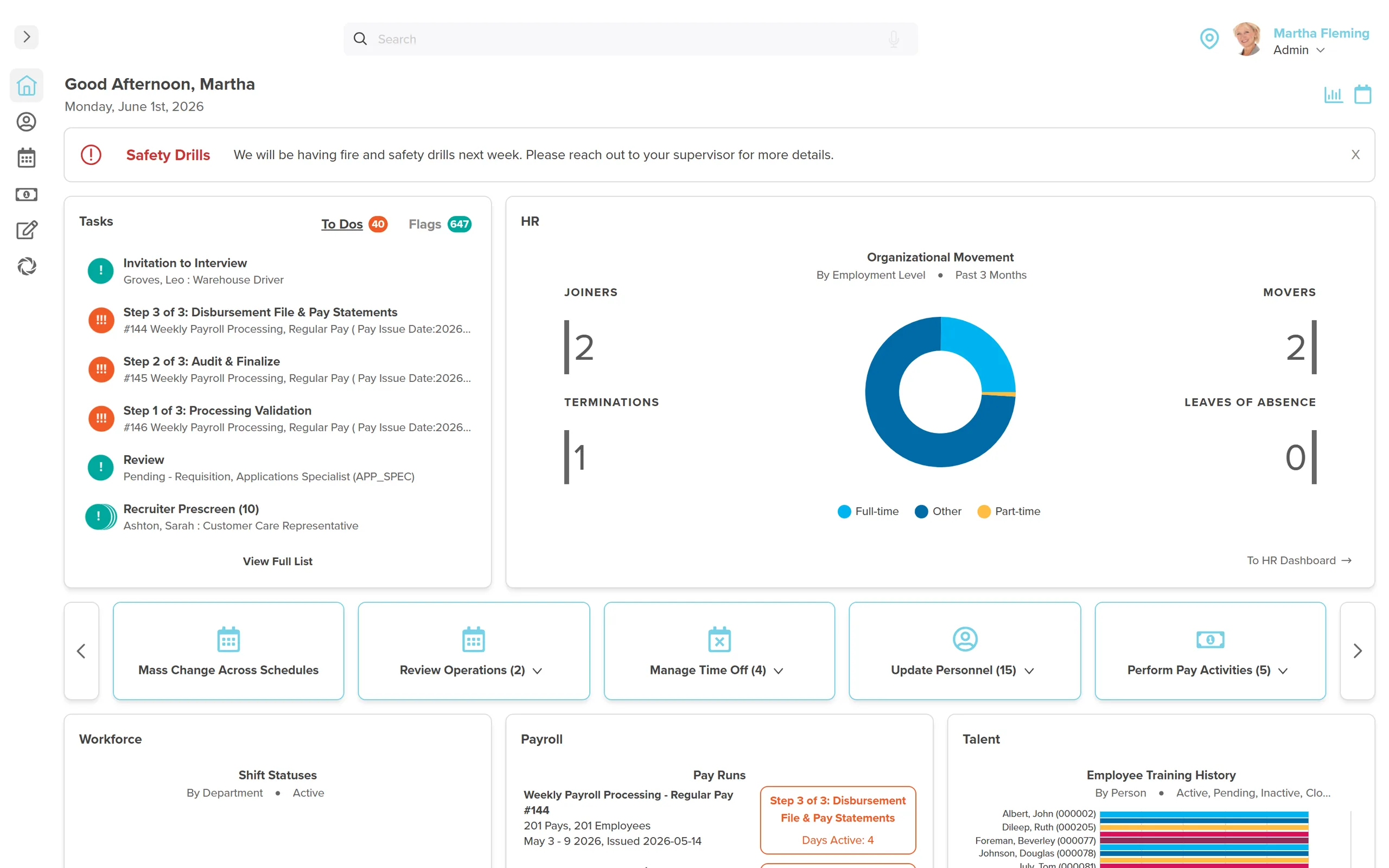
Put the survey on the same employee record as pay, time, and performance, and the score stops being an orphan.
Results segment themselves by department, location, and tenure, because the record already knows those things. Favourability compares against company and department benchmarks instead of floating alone. Reporting visibility follows role, so a location manager sees their own site and corporate sees the roll-up. And when a review cycle opens, the engagement picture already sits beside the performance one. No export, no second login, no tool to reconcile.
Distribution runs off the real structure too, person by person. That one turns out to be the whole story for a dealership group in Saskatchewan.
| Survey in a separate tool | Survey on the record |
|---|---|
| Scores arrive as company-wide averages | Scores segment by department, location, and tenure automatically |
| Correlation means exporting and joining by hand | Engagement sits beside pay, time, and performance on one record |
| Distribution follows the tool's org template | Distribution follows your real structure, person by person |
| A separate subscription to renew and maintain | Included in the platform you already run |
None of that costs you anonymity. The segmentation comes from the record, not from unmasking anyone: managers see how a group feels, never how a person answered.
The company that moved years of listening without losing it
Driving Change Automotive Group runs dealerships across Saskatchewan and Alberta. Engagement was never their gap. They had run surveys for years on SurveyMonkey, and the question structure held steady enough that leadership trusted the trend line and used it for culture and retention decisions.
The problem was structural. The tool sat outside the HRIS, at roughly $10,000 a year, and correlating anything meant exporting responses and joining them to HR data by hand. Worse, distribution followed the tool's idea of an org chart. DCAG's real structure spans brands, layered management, and team leads who run crews without holding a manager title. The tool couldn't see them.
Not a new program. Their program, attached.
So the move into Workzoom kept the categories, the question formats, and the reporting approach intact. We've seen this kind of move up close, and the whole job is continuity: every category and question format came across unchanged, so this quarter's score still sits on the same axis as the one from two years back. The trend line stayed unbroken.
The new part came from the record. Results linked by person rather than title, so those team leads finally showed up in the reporting. Targeted surveys went to specific groups. Response data arrived in real time instead of after a closing date. And the $10,000 subscription retired, because the survey engine was already included in the HR platform they were paying for.
There's a trap in that story if you're switching tools: the question history is the asset. Change the structure and you break comparability with every cycle you've ever run. Ask any vendor, us included, to show you exactly how your existing categories and formats carry over. Treat "you'll love our new questions" as the warning sign it is.
Listening has to be attached to something
If your engagement program produces dashboards and no decisions, stop rewriting the questions. It's not you.
The plumbing is.
The same signals surface in exit interviews, where the listening happens after it can change anything. They surface again in the manager behaviours that drive retention, which pulse data can flag by group when it knows who reports to whom.
In Workzoom, engagement surveys are part of the base HR suite at $4 USD per employee per month, not an add-on. Pulse checks, polls, and targeted surveys run against the live employee record, results in real time, anonymity intact. The full platform ranges $4 to $16 per employee per month, with no setup fees, no contracts, and implementation included. The full story is in the DCAG case study.
Come November, somewhere, another annual survey will close. Its deck will land in a March meeting, and leadership will nod. So will the manager half the floor dreads. Continuous listening is the right instinct about that ritual. But listening only works if it is attached to something. Attach it to the record.
See Workzoom in 30 minutes.
Real product, real questions, no slides. Starts at $4 per employee per month, CAD or USD, with $0 setup fees.
What readers ask after this post on continuous listening employee engagement.
Our clients
The teams that run their people on Workzoom.













Workzoom handles HR, payroll, workforce, and talent on one employee record. Book a 30-minute walkthrough.