 Canada
 United States
 Bahamas
 Jamaica
 Trinidad & Tobago
 Antigua & Barbuda
 Barbados
 Anguilla
Severance Pay Ontario 2026: What the ESA Owes

Ontario is the only province that makes employers pay twice. There is termination notice, which every province has, and there is statutory severance pay, which only Ontario adds on top. They are separate entitlements with separate tests and separate caps, and they stack. Employers who calculate one and stop have underpaid.
Ontario makes employers pay twice on a termination without cause. Notice is capped at 8 weeks. Severance pay is capped at 26 weeks. Most Ontario employers calculate the first, miss the second, and close the file.
Under Ontario's Employment Standards Act, an employee whose employment is severed after five or more years of service is entitled to severance pay equal to regular wages for a regular work week multiplied by the sum of completed years of employment plus completed months divided by 12 for a year that is not completed, to a maximum of 26 weeks, if the employer has a global payroll of at least $2.5 million or severed 50 or more employees in a six-month period because all or part of the business permanently closed. Severance pay is separate from and additional to termination pay. It is separate from, and paid in addition to, termination notice, which the ESA caps at 8 weeks. See the worked example below for how the two stack for a long-service employee.
The error is rarely a bad calculation. It is calculating one entitlement, treating it as the whole obligation, and closing the file.
- Two entitlements, not one. Notice caps at 8 weeks. Severance pay caps at 26 weeks. They stack.
- Severance pay needs 5 years of service and a $2.5 million global payroll, or a 50 employees permanent closure.
- Partial years count for severance pay. They do not count for notice.
- Remote work can affect who counts toward the mass termination headcount; see the mass termination section for how Ontario defines an employer's establishment.
- In a mass termination, notice runs from the day the Director receives Form 1, not the day you tell the employee.
The Notice Table
Termination notice is the entitlement every Ontario employee with at least 3 months of continuous service has. It is a step table, not a per-year multiplier, and the steps stop moving once an employee's service reaches the top band. The figures below are the table published by the province in its guide to termination of employment.
| Period of employment | Notice required |
|---|---|
| Less than 1 year | 1 week |
| 1 year but less than 3 years | 2 weeks |
| 3 years but less than 4 years | 3 weeks |
| 4 years but less than 5 years | 4 weeks |
| 5 years but less than 6 years | 5 weeks |
| 6 years but less than 7 years | 6 weeks |
| 7 years but less than 8 years | 7 weeks |
| 8 years or more | 8 weeks |
Note what the table does not do. It does not reward the difference between an employee who has only cleared the top band and one who has served decades longer. Both are owed the same statutory notice. That flat ceiling is precisely why Ontario legislated a second entitlement for long-service employees, and why the common law layer exists on top of both.
Severance Pay Ontario: The Second Entitlement
This is not more notice. It is compensation for the loss of long service, and it answers a different question. Per the province's severance pay guidance, an employee qualifies only if they have 5 years or more of employment and the employer also meets a payroll-size or mass-closure condition:
- The employer has a payroll of at least $2.5 million, or
- The employer severed the employment of 50 employees or more within a 6 months period because all or part of the business permanently closed.
The payroll figure carries a trap that catches employers with a small Ontario footprint. The $2.5 million test looks at the employer's global payroll, not its Ontario payroll. A company running a small Ontario office as part of a much larger international business will usually meet the threshold on payroll it does not pay in Ontario at all. Employers who assume provincial legislation only counts provincial employees get this wrong in the direction that costs money.
The Formula, Including the Part Everyone Rounds Away
1 week per year up to 26 weeks, 5+ years service, employer's global payroll $2.5M+ or 50+ employee closure
Unlike the notice table, this one counts a partial final year as a fraction rather than rounding it away. A hypothetical employee whose service includes twelve completed years plus six completed months beyond that earns twelve and a half weeks, not twelve. A hypothetical employee at nine completed years plus eleven completed months beyond that earns slightly under ten weeks, not nine. Rounding down to the last completed year is a small error on any single file and a systematic underpayment across a workforce.
What the Stack Looks Like
Picture a hypothetical employee at an employer whose global payroll clears the $2.5 million threshold, terminated without cause after fifteen years and four months. Termination notice tops out at 8 weeks, the statutory maximum; a hypothetical employee who has only cleared the top band of the notice table is owed the same notice as this one. Severance pay does not flatten the same way: applying the formula above to fifteen completed years and four completed months of service produces slightly over fifteen and a third weeks, on top of the notice. An employer who calculated only the notice table would have paid against its maximum and stopped there, short of the full statutory total. The ESA floor is not a defensible position in that scenario, and the shortfall only grows once an employee has spoken to a lawyer about common law notice.
Mass Terminations and the Form 1 Trap
Where 50 employees or more are terminated at one establishment within a four weeks period, the individual notice table is replaced entirely. Group notice applies to everyone in the group, regardless of individual service:
- 50 employees to 199 employees: 8 weeks
- 200 employees to 499 employees: 12 weeks
- 500 employees or more: 16 weeks
The procedural requirement is where employers lose money without realising it. The employer must submit a completed Form 1 to the Director of Employment Standards, post a copy in the workplace, and give a copy to each affected employee. The notice period does not begin until the Director receives the Form 1. An employer who notifies staff and files with the Director two weeks later has not saved that time. It has added two weeks of pay in lieu.
Remote Work and the Establishment Definition
For Ontario's mass termination rules, 'establishment' includes an employee's home if the employee works exclusively from home and does not work at any other location where the employer carries on business. Since this change, employees who work exclusively remotely must be considered for inclusion when determining whether an employer has terminated 50 or more employees within a four-week period. Confirm the current wording on the Ministry of Labour's termination of employment guide before excluding a distributed team from a mass termination headcount, or assuming it is excluded.
Employers restructuring a distributed team should not assume a scattered workforce falls outside group notice by default. Since this change, an employee who works exclusively from home and does not work at any other location where the employer carries on business counts the same as an employee who reports to an office.
When Nothing Is Owed
The ESA exemption is narrower than most employers assume, and narrower than common law just cause. Under the regulation defining the ESA's misconduct exemption, an employee loses the right to both notice and severance pay only where they are guilty of wilful misconduct, disobedience or wilful neglect of duty that is not trivial and has not been condoned by the employer. Confirm the current wording of that regulation directly with the Ontario Ministry of Labour before relying on it.
Ontario courts read "wilful" strictly. The conduct must be intentional and deliberate, something the employee did knowing it was wrong. Carelessness does not meet it. Poor performance does not meet it. Incompetence, however serious, does not meet it, because incompetence is not deliberate. An employer can hold genuine common law just cause and still owe the full statutory entitlement, which is a distinction worth resolving before the cheque is written rather than at a hearing.
The two qualifiers matter as much as the standard. Misconduct that is trivial does not qualify. Misconduct the employer knew about and tolerated has been condoned, and condoned misconduct cannot later be used to withhold statutory pay.
The ESA Is the Floor, Not the Number
Everything above describes the minimum an Ontario employer can lawfully pay. It is not an estimate of exposure. Employees without an enforceable termination clause are entitled to common law reasonable notice, which is assessed on the Bardal factors and routinely produces multiples of the statutory figure for long-service and senior employees.
The contract that was supposed to cap that exposure often does not. In Waksdale v. Swegon North America Inc., 2020 ONCA 391, the Ontario Court of Appeal held that a severability clause cannot have any effect on clauses of a contract that have been made void by statute, and that termination provisions in an employment agreement must be interpreted as a whole rather than piecemeal, so that a provision violating the Employment Standards Act voids the entire termination clause even if the provision relied on to terminate the employee was itself compliant. A great many contracts still in force were drafted before that decision.
For the common law layer, the Bardal analysis, and how the other provinces and the federal jurisdiction differ, see our guide to severance pay across Canada. To model the statutory stack against a specific salary and tenure, use the Canada severance calculator. If your payroll also runs in BC, Quebec, or Alberta, see our Ontario payroll software page for how the $2.5 million test and the other Ontario-specific rules sit alongside each province's own.
Two downstream obligations travel with every Ontario termination and are easy to lose in the arithmetic. The Record of Employment is due to Service Canada on a deadline that does not wait for the severance negotiation to settle, and the codes you enter drive the employee's EI claim: see our Record of Employment guide. Termination and severance payments are also employment income, so they carry source deductions and land in a remittance period like any other payroll, which our CRA remittance guide covers.
Getting the Arithmetic Out of a Spreadsheet
Most of the failures above are not legal misunderstandings. They are record-keeping failures. The partial-month fraction needs an accurate continuous-service date. The $2.5 million test needs a global payroll figure that an Ontario HR lead may never see. The 50 employees threshold needs a count across a four weeks window that spans more than one manager's decision.
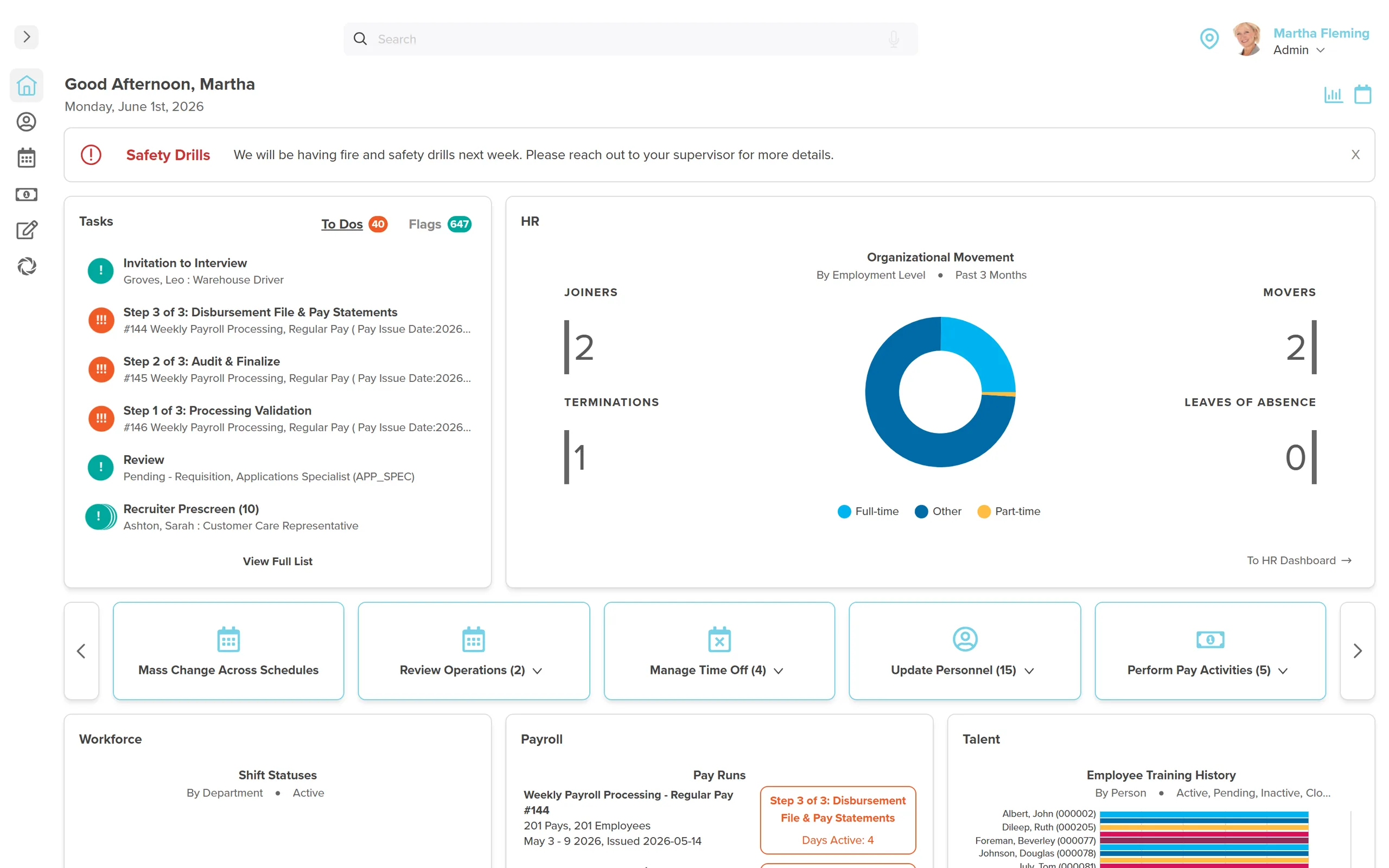
Workzoom holds continuous service dates, regular weekly wages and organization-wide payroll totals in a single employee record, so a termination calculation reads from the same data the payroll runs on, as opposed to a spreadsheet rebuilt from scratch each time someone leaves.
County of Renfrew, an Ontario municipal employer with 900 employees, runs on that model. Every role change and tenure milestone is effective-dated and traceable back to the start of employment, so the continuous-service date a severance calculation depends on is not reconstructed under deadline. It is already there.
That is not a legal problem. It is a records problem, and records problems are fixable.
Termination Math That Reads From the Payroll Record
Continuous service dates, regular weekly wages and organization-wide payroll totals on a single employee record, effective-dated, so notice and severance calculate from the same source the payroll runs on. See pricing for how suites are costed.
Book a 30-Minute Walkthrough- Your guide to the Employment Standards Act: Termination of employment claim checked Sep 4, 2026
- Your guide to the Employment Standards Act: Severance pay claim checked Sep 4, 2026
- Your guide to the Employment Standards Act: Termination of employment claim checked Sep 4, 2026
- Your guide to the Employment Standards Act: Termination of employment in effect since Oct 26, 2023 claim checked Sep 4, 2026
- Waksdale v. Swegon North America Inc., 2020 ONCA 391 claim checked Sep 4, 2026
See Workzoom in 30 minutes.
Real product, real questions, no slides. Starts at $4 per employee per month, CAD or USD, with $0 setup fees.
What readers ask after this post on severance pay Ontario.
Our clients
The teams that run their people on Workzoom.













Workzoom handles HR, payroll, workforce, and talent on one employee record. Book a 30-minute walkthrough.