 Canada
 United States
 Bahamas
 Jamaica
 Trinidad & Tobago
 Antigua & Barbuda
 Barbados
 Anguilla
CUPE Payroll for a Children's Aid Society

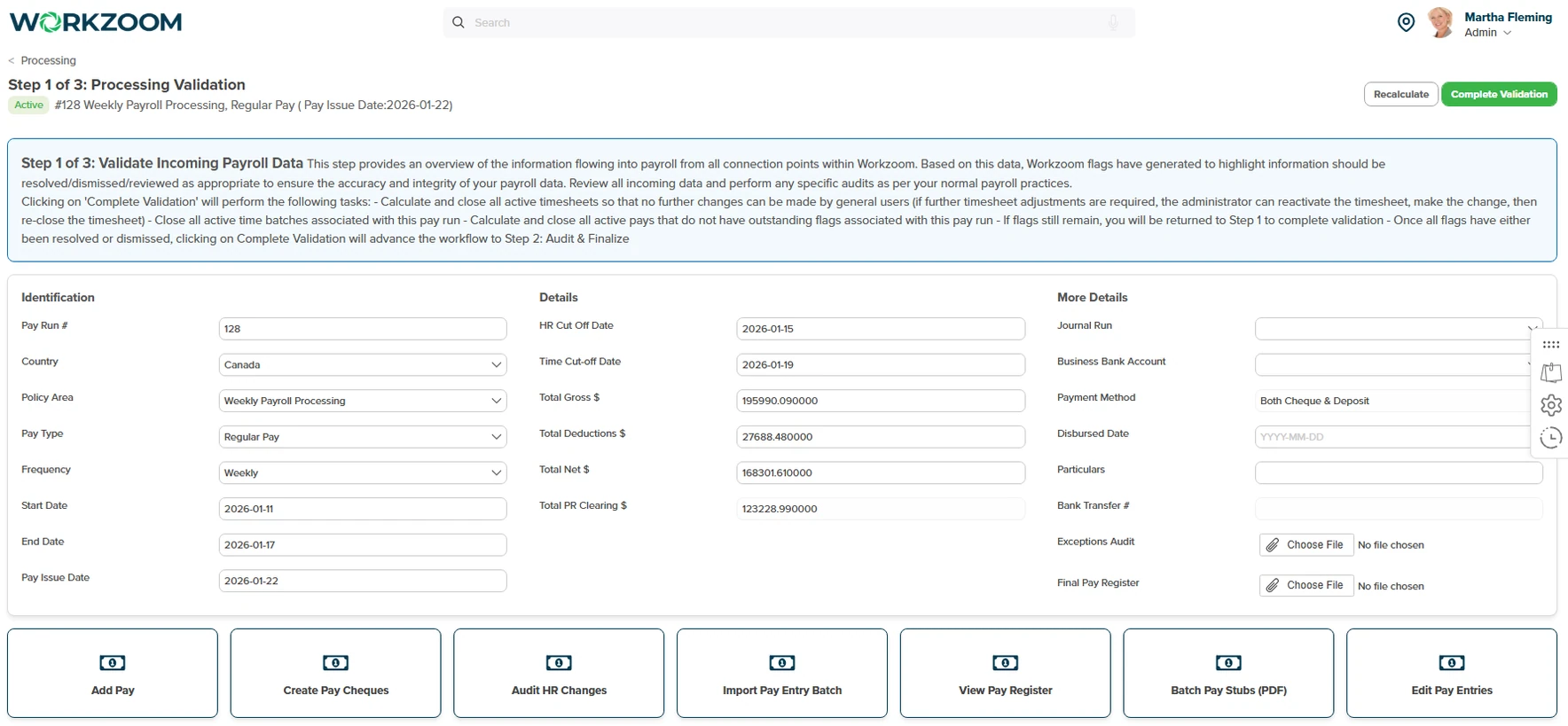
A single missed pay-grid step, repeated across 30 employees for 18 months, builds a retroactive liability no Children's Aid Society wants to discover in a union audit. CUPE payroll for a Children's Aid Society requires each collective agreement configured as a distinct pay group, with pay grid steps that advance automatically on service anniversaries, on-call premiums that calculate from the schedule, and overtime rules specific to the local, not generic defaults. Workzoom handles this for Toronto Catholic CAS, Huron-Perth CAS, and Sarnia-Lambton CAS.
- CUPE child welfare agreements have step progressions, on-call minimums, and after-hours premiums that most payroll software handles wrong.
- Step progressions are contractual obligations. Miss one and it's not a correction, it's a grievance.
- If your payroll staff add a manual verification step after every run, the software hasn't solved the problem.
- When the agreement renegotiates, the update should be a configuration change, not a custom development project.
CUPE child welfare collective agreements don't care that your payroll software wasn't built for them.
The step progressions still apply. The on-call minimums still apply. The after-hours premium on a statutory holiday still applies. And when the calculation is wrong, the union notices before you do.
Most CAS payroll operations deal with this the same way. They run payroll. Then someone pulls the collective agreement and checks the output manually. Compares what the system calculated against what the agreement says it should be. Corrects the discrepancies. Approves the run.
That manual check step is not a process. It's a symptom. A symptom of a system that wasn't configured to understand the agreement in the first place.
CUPE Payroll Children's Aid Society: Steps That Move Whether You Track Them or Not
Pay grid step progressions are the first place generic payroll software fails on a CAS collective agreement.
A new caseworker enters at step one of the pay grid for their classification. Each year on their service anniversary, they advance one step. The rate is in the agreement. It's not discretionary. It's not subject to performance review. It happens on the anniversary date.
For a 150-person CAS where caseworkers are at various stages in their step progression, all with different anniversary dates, some having entered the organization at different grid positions, manually tracking which steps are due in which pay period is a real administrative task. One that gets missed when the payroll administrator is busy, sick, or on leave.
Miss a step and the correction is retroactive. Miss it systematically across 30 employees over 18 months and the retroactive liability is significant. The union audit will find it. The grievance will follow.
Workzoom tracks service anniversaries and applies step increases in the correct pay period automatically. No calendar. No spreadsheet. No risk.
Bring your collective agreement to the demo. We'll configure it and run a payroll preview.
Step progressions, on-call premiums, after-hours pay, and classified versus non-classified staff in one platform. Trusted by Toronto Catholic CAS, Huron-Perth CAS, and Sarnia-Lambton CAS. $4 per employee per month per suite. No setup fees. No contracts.
Tell Us What You Need to See2am on a Statutory Holiday
On-call provisions are where CAS collective agreements get genuinely complex.
Standby pay for being on-call. Callback pay when actually called in. A minimum guaranteed number of hours when called in, say, three hours, regardless of whether the call lasted 20 minutes. Different rates on weekdays, weekends, and statutory holidays. Some agreements have a minimum callback rate that applies even for a phone resolution with no physical response.
A caseworker called in at 2am on Christmas Day is owed a specific amount under their collective agreement. The calculation involves the regular rate, the statutory holiday premium, and the callback minimum. That's not something a payroll administrator should be computing from memory and entering as a manual line item after the fact.
On-call rotation configured in the scheduling module, with the agreement's premium structure entered once during implementation, means the pay calculates from the schedule. The caseworker completes the on-call shift. The system sees the schedule. The premium flows into the payroll run. No manual entry. No memory required.
The Manual Check Step
Here's the real cost of payroll software that wasn't built for a CAS collective agreement.
Not the occasional incorrect calculation, though that matters. The real cost is the verification step that gets added to every single payroll run because the team doesn't trust the output.
Every payroll run adds a manual check pass. On a biweekly schedule that compounds fast. Hours of a payroll administrator's time each month spent confirming that the software did what it was supposed to do.
If the agreement rules are configured correctly, the check disappears. Not because anyone is being reckless. Because the system earns the trust by getting it right consistently.
That manual verification pass is the pattern we see across our Canadian client base running unionized payroll: a team that quietly rebuilds, by hand, the calculation their software was supposed to own.
What Renegotiation Looks Like in a Real System
CUPE agreements renegotiate. Rates change. Sometimes entitlements change. The agreement from three years ago isn't the agreement that governs payroll today.
In a system that wasn't designed for collective agreements, renegotiation means a support ticket, a custom development request, or a manual adjustment that someone maintains as a separate spreadsheet until the vendor gets around to it.
In Workzoom, renegotiation is a configuration update with an effective date. New pay grid rates apply from the day the renegotiated agreement takes effect. Historical pay is preserved at the old rates. The retroactive period between agreement expiry and ratification can be calculated as a separate adjustment. No custom development required.
If you are the one running the manual check after every payroll, you're not the problem. The truth is the software is. That's not a discipline gap. That's a configuration gap, and it sits with the system, not with you.
Workzoom is trusted for CUPE collective agreement payroll by Toronto Catholic Children's Aid Society (380 employees), Huron-Perth CAS, Sarnia-Lambton CAS, and Children's Aid Society of the District of Thunder Bay. Pricing: $4 per employee per month per suite, no setup fees, no contracts. Save 5% with annual billing. Full platform is $16 per employee per month. Implementation, data migration, training, and support included.
More at workzoom.com/industries/childrens-aid. External reference: CUPE collective bargaining resources cover the structure of child welfare collective agreements across Canadian provinces.
See Workzoom in 30 minutes.
Real product, real questions, no slides. Starts at $4 per employee per month, CAD or USD, with $0 setup fees.
What readers ask after this post on cupe payroll children's aid society.
Our clients
The teams that run their people on Workzoom.













Workzoom handles HR, payroll, workforce, and talent on one employee record. Book a 30-minute walkthrough.