 Canada
 United States
 Bahamas
 Jamaica
 Trinidad & Tobago
 Antigua & Barbuda
 Barbados
 Anguilla
Connected HRIS: From Hire to Pay on One Employee Record

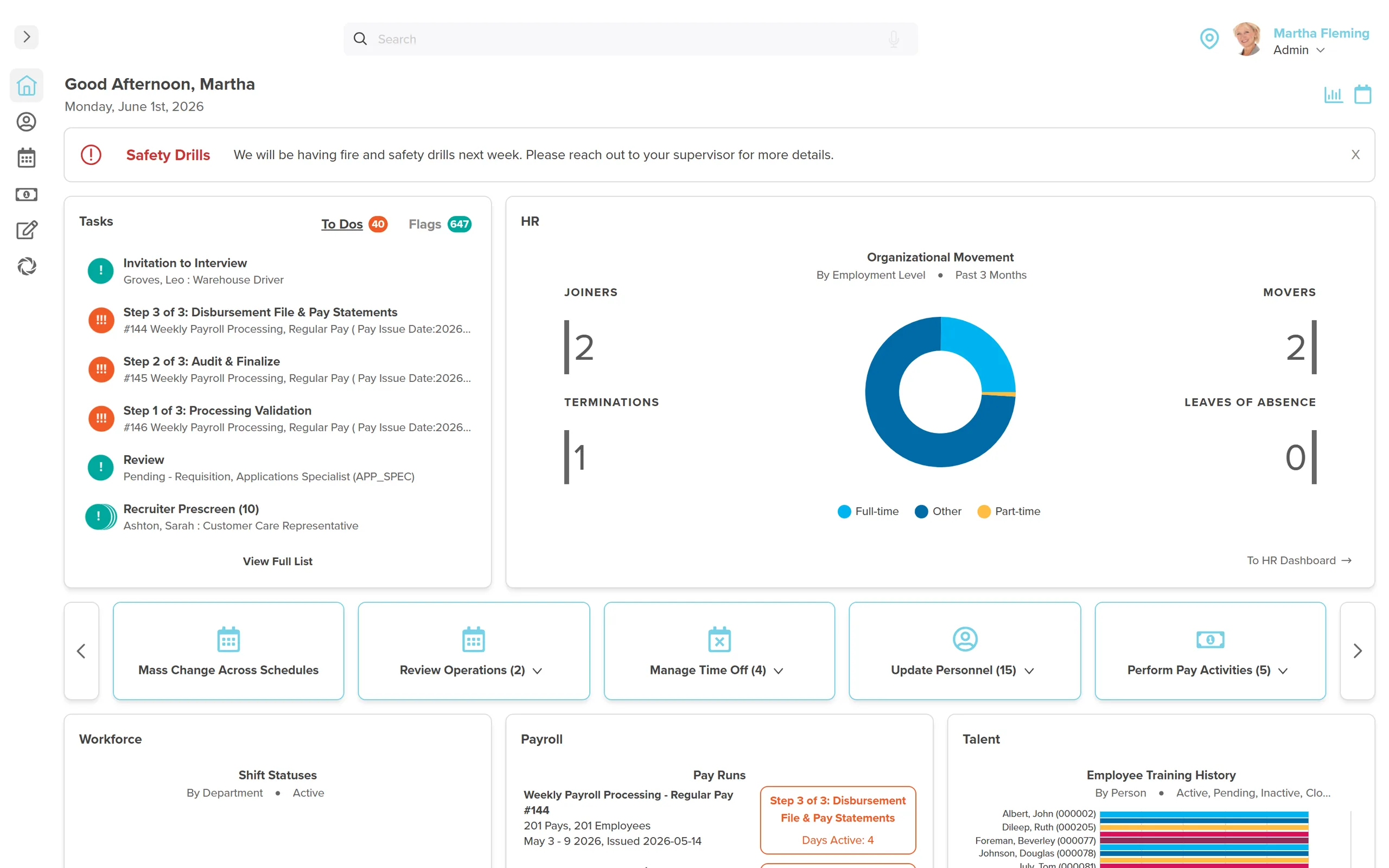
Most HRIS platforms aren't actually connected. A connected HRIS is a human resources information system where HR, leave, scheduling, time, performance, and payroll all run on a single employee record. Data moves between functions on the same engine, not through CSV exports between four products. The difference shows up in pay cycle time, onboarding speed, and how many systems your team has to keep in sync.
Workzoom is a connected HRIS that runs Cable Bahamas (850 employees, payroll processing cut from 5 days to 1.5), County of Renfrew (900 employees, 32 new hires onboarded paper-free in a single pay period), and Island Luck (850 employees across 60-plus gaming locations) on this model. This guide walks through what connection means in practice, the workflows that break without it, and how to evaluate a platform that claims to be connected.
Across our client base, the pattern we see is the same. Connection isn't a feature you bolt on at the end. It's the difference between one connected platform and the four-product all-in-one stack that still bridges files overnight. If your team spends pay week reconciling exports between systems, it's not you. It's the architecture.
What a Connected HRIS Means in Practice
A connected HRIS runs every HR function in the same place. When a worker is hired, scheduled, takes leave, gets reviewed, or moves through payroll, the platform is reading and writing the same data. There are no exports between modules. There is no separate "payroll system" sitting next to the "HR system" with a nightly CSV bridge between them.
The term gets confused with "all-in-one HR software." They overlap, but the difference matters. An all-in-one platform offers multiple HR functions under one login. A connected HRIS goes further: every function shares the same data layer, so a status change in HR cascades automatically into Scheduling, Payroll, and Benefits Administration without manual re-entry. Many platforms marketed as all-in-one are four products on shared sign-on with file-based bridges between them.
The architectural distinction is whether you have one employee record or multiple coordinated records. One record means a change made anywhere is visible everywhere instantly. Multiple coordinated records means someone (or something) has to reconcile.
Workzoom single-database architecture
"All-in-one" describes the user interface. "Connected" describes the data layer. The platforms most people want are the ones where the same data handles everything from hire to pay, with no exports between modules. Workzoom is built on this architecture.
The Workflows That Break Without Connection
You can hire, schedule, and pay people on disconnected systems. The question is what it costs you to do it that way. Seven workflows reveal the hidden cost.
1. Hire to first paycheck. A new hire's record exists in Recruiting, then has to be re-keyed into Payroll, then re-keyed into Time and Attendance, then re-keyed into Benefits Administration. Each re-entry introduces error and delays.
2. Time tracking to payroll. Hours captured in one system have to export to another before they can become pay. The export window controls how late payroll can run. Errors in the export become pay disputes.
3. Leave to scheduling. An approved vacation in the leave system needs to remove the worker from the schedule. If the integration is one-way (or absent), managers schedule workers who are on leave, then catch the conflict later.
4. Performance to compensation. Performance ratings produced in one tool have to inform comp decisions made in another. When the link is a spreadsheet, the data ages between cycles. When the link is automated, the next merit cycle runs on current data.
5. Certification expiry to scheduling. A lapsed certification needs to be flagged before dispatch or assignment for credentialed roles (caseworkers, healthcare workers, drivers, field crews). If certifications live in a separate Learning system that doesn't surface at scheduling time, the credential expires silently and the regulatory risk surfaces on audit.
6. Termination to final pay and benefits. A termination updates the HR record, but final pay calculations, accrued leave payouts, and benefits termination depend on accurate data flowing to Payroll and Benefits Administration on the right effective date.
7. Compliance reporting. Annual reporting (T4s, ROEs, statutory deduction summaries, plus the staffing and headcount data behind sector filings like CYFSA Part V investigation reporting for children's aid societies or MTO driver abstract tracking for trucking operators) pulls from every function. When the data lives in four systems, reporting becomes reconciliation. When it lives in one place, reports and exports run on live data.
None of these workflows are unique to large organizations. They show up in every business that has employees on more than one schedule, with more than one credential, and any kind of pay variation.
What Connection Looks Like at Cable Bahamas
Cable Bahamas runs Workzoom across 850 employees in HR, Talent, Workforce, and Payroll. Shanika Pinder, the payroll manager, describes the operational reality:
"3 people deal with close to 1,000 people. It's been seamless integration of our timekeeping, our HR and payroll systems with no need for manual data transfer. The foot traffic in payroll and HR has reduced tremendously."
Shanika Pinder, Compensation & Payroll Supervisor and HR Business Partner, Cable BahamasThe operational numbers from the Cable Bahamas case study: payroll processing dropped from 5 days to 1.5 days. That is a 70 percent cycle-time reduction without adding staff. Three payroll team members run the entire operation. The same three people were running it before the switch, when payroll took 5 days.
The reduction in foot traffic between payroll and HR is the manual reconciliation that disappears when both functions read from the same place. Three people. Close to 1,000 employees. 1.5 days.
Onboarding 32 New Hires Paper-Free at County of Renfrew
The County of Renfrew runs Workzoom across roughly 900 municipal employees. Greg Belmore, Manager of Human Resources, describes a hiring cycle that would be operationally impossible on disconnected systems:
"We wouldn't be able to hire the people that we do anymore with the same resources we already had. It's allowed us to keep our headcount consistent without needing to increase, saving us time and money."
Greg Belmore, Manager of Human Resources, County of Renfrew32 new hires onboarded in a single pay period, paperless, with TD1s, banking, training acknowledgements, and orientation completed before day one. Each of those new hire records flows directly into Scheduling and Payroll without re-keying. That throughput only exists when one platform holds everything.
On a module-by-module stack, the same 32 hires require: data entered into Recruiting, re-keyed into HR, re-keyed into Payroll, re-keyed into Time and Attendance, paper forms for TD1s, separate sign-in for training, manual handoff for orientation. The bottleneck is not the hires. It is the system architecture.
Connected HRIS vs Module-by-Module Stacks
The module-by-module stack pattern shows up in several familiar combinations:
- BambooHR plus ADP: BambooHR for HR and onboarding, ADP for payroll, separate scheduling tool, performance reviews in a third platform. Common in growing US-headquartered companies.
- Rippling with point-solution add-ons: Rippling as the spine, with point solutions for scheduling, time tracking, or specialty payroll layered on. Marketed as connected but the customer often owns the integration work.
- Gusto plus Deputy: Gusto for payroll, Deputy for scheduling and time, separate HRIS for performance. Common in SMB.
- SuccessFactors plus separate payroll: Enterprise pattern where the talent suite and the payroll engine are different products.
These stacks work. They run real organizations. The trade-off is operational: every integration becomes the customer's problem. CSV bridges break. Vendor API changes ripple. Reconciliation eats payroll cycle time. When something goes wrong, four vendors point at each other.
A connected HRIS removes the integration layer because there is no second product to integrate with. The trade-off the other direction is fewer best-of-breed feature points. The right choice depends on what you prioritize: deep feature coverage in each function, or operational simplicity across all functions.
For organizations under 5,000 employees running standard HR, payroll, scheduling, and performance, the operational simplicity usually wins. The ROI calculation favors connection because the time recovered from reconciliation, the pay errors avoided, and the compliance gaps closed compound every cycle.
"We needed a platform that streamlined a growing number of processes within our organization. We chose Workzoom because their platform solved 95 percent of our people management issues."
Terhemba M., GM HR (G2 verified review)How to Evaluate a Connected HRIS in a Demo
Vendor claims about being "connected" or "all-in-one" need to be tested against actual workflow flow. Four tests separate connected HRIS platforms from coordinated stacks.
Test 1: New hire flow. Add a new hire in Recruiting. Watch the record flow into Onboarding, HR, Scheduling, and Payroll. If the record requires re-entry at any step, or if any step requires CSV export, the platform is not connected. Ask to see the new hire show up in a pay run without manual setup.
Workzoom routes the new hire from offer acceptance through digital onboarding (TD1s, banking, training acknowledgements, policy sign-offs) directly into Scheduling and Payroll. County of Renfrew validated this at 32 hires in one pay period.
Test 2: Leave approval flow. Approve a vacation request in the leave system. Open the Scheduling view. The worker should be unavailable for the leave dates automatically. Open the Payroll view. The accrual should be reflected without manual adjustment. If either side requires manual sync, the leave function is bolted on.
Test 3: Credential expiry flow. Set a certification with an expiry date on an employee. Schedule the employee for a shift past the expiry. The platform should either block the assignment or surface an active warning. On a disconnected stack, Learning lives apart from Scheduling and the credential expires invisibly.
Test 4: Payroll run from live data. Run a pay calculation. Confirm that time hours, leave deductions, premium pay, and compensation changes are all drawing from the same place without prior export. If the vendor talks about "syncing" data into the payroll module before each run, the architecture is coordinated, not connected.
If a platform passes all four tests with real data (not a sanitized demo environment), the connected claim is real. Workzoom demos run on production data with these four tests deliberately included.
What Workzoom Builds Connection On
The platform covers Payroll Management, Time and Attendance, Scheduling, Learning, Recruiting and Applicant Tracking, Benefits Administration, Performance Management, Career Planning, and Succession Planning. All of it runs in one place. Status changes, leave approvals, schedule shifts, credential updates, performance scores, and pay run calculations all read and write the same data, with no exports between modules.
Crystal Murray at Silvera for Seniors described the pre-Workzoom state as a place where "nothing spoke to each other." Silvera now runs HR and time and attendance for about 400 employees across its Calgary buildings on one connected record, so punch-clock data no longer has to be fixed by hand before anyone can use it. The same connected architecture handles Cable Bahamas' multi-island payroll, Island Luck's 8 payroll runs per week across 60-plus gaming locations, and the County of Renfrew's 32-hire onboarding cycles.
From Hire to Pay: Why It Has to Be One Record
An HRIS is not a feature list. It is a data architecture. The decision a buyer is making is whether to run their workforce on one connected record or on coordinated records across multiple products.
The trade-offs are concrete. Connected HRIS gives you fewer feature peaks in any one function but removes the operational tax of integration work, manual reconciliation, and cross-system errors. Module-by-module stacks give you deeper feature coverage in each function but make the integration layer your problem to maintain.
For mid-market organizations between 50 and 5,000 employees running standard HR, scheduling, time, and payroll, the math usually favors connection. The proof points are not hypothetical. Cable Bahamas cut payroll cycle time by 70 percent. County of Renfrew onboards 32 new hires per pay period on paper-free workflows. Island Luck runs 8 payroll cycles per week across 60-plus locations. Each of them runs the whole journey from hire to pay on one connected platform.
The question is whether the workflow tax you are paying today is bigger than the switch.
See Workzoom in 30 minutes.
Real product, real questions, no slides. Starts at $4 per employee per month, CAD or USD, with $0 setup fees.
What readers ask after this post on connected HRIS.
Our clients
The teams that run their people on Workzoom.











Workzoom handles HR, payroll, workforce, and talent on one employee record. Book a 30-minute walkthrough.