 Canada
 United States
 Bahamas












Employees see balances before requesting leave
Employees see the leave types they are entitled to and their balances in self-service. Remaining excludes Booked future leave, so both figures matter when planning a request.
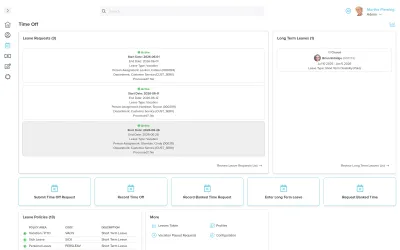
Employees see their remaining balance and future leave booked separately before requesting time off. Managers approve with the team calendar in view. HR and payroll use the same leave dates, with rules configured for each policy and jurisdiction.
Our clients
Benefits
Employees see the leave types they are entitled to and their balances in self-service. Remaining excludes Booked future leave, so both figures matter when planning a request.
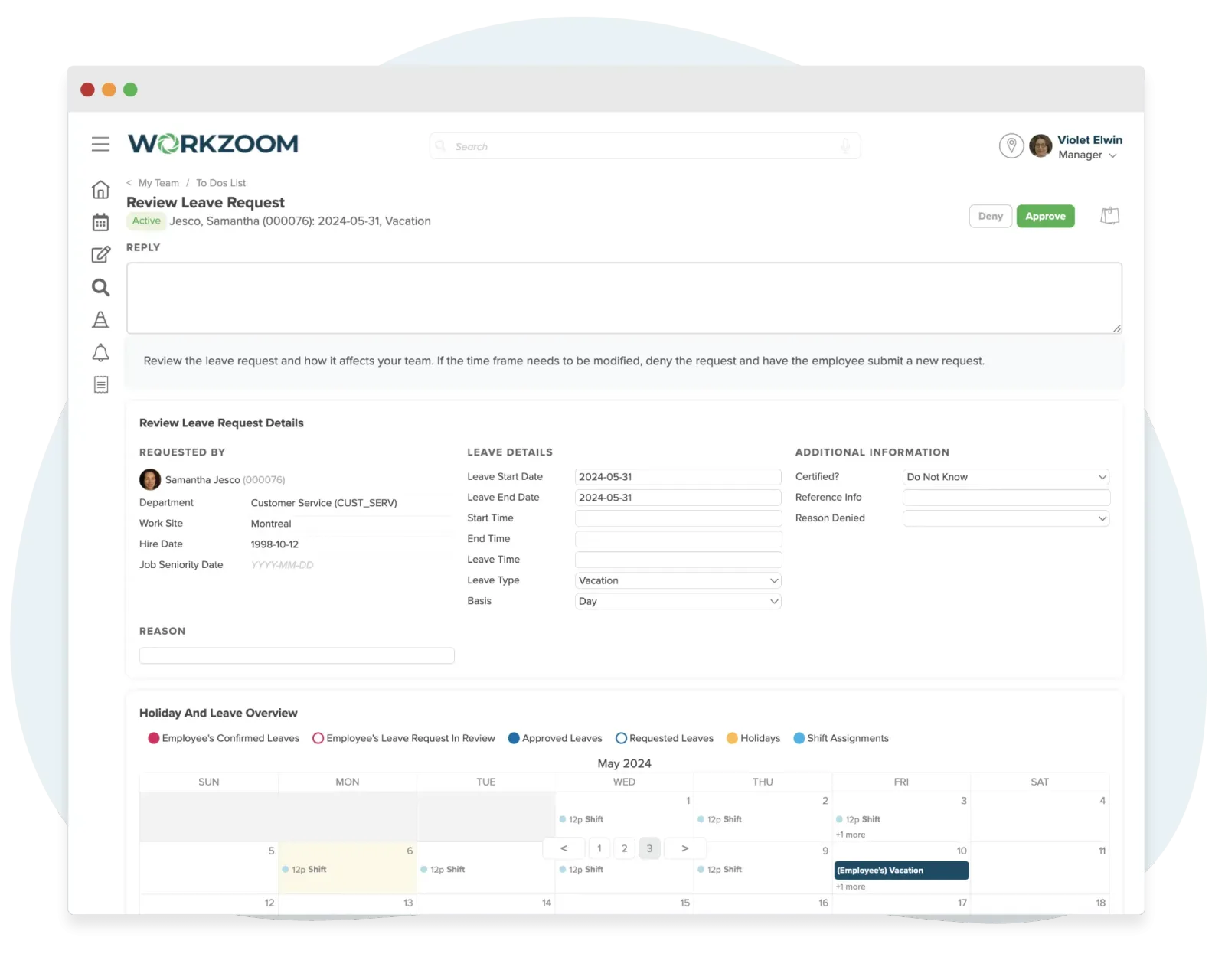
Review the requestor, duration, reason, balance, team coverage and qualified substitutes before approving or declining the request.
Where scheduling is enabled, approved full-day leave creates a vacancy. Partial-day leave adjusts the schedule. A manager still assigns any replacement needed.
Set leave types, accruals, entitlements and carryover for the employee groups your organization uses. Policy settings drive the calculation; your team validates eligibility, employment requirements and changes rather than assuming the rules maintain themselves.
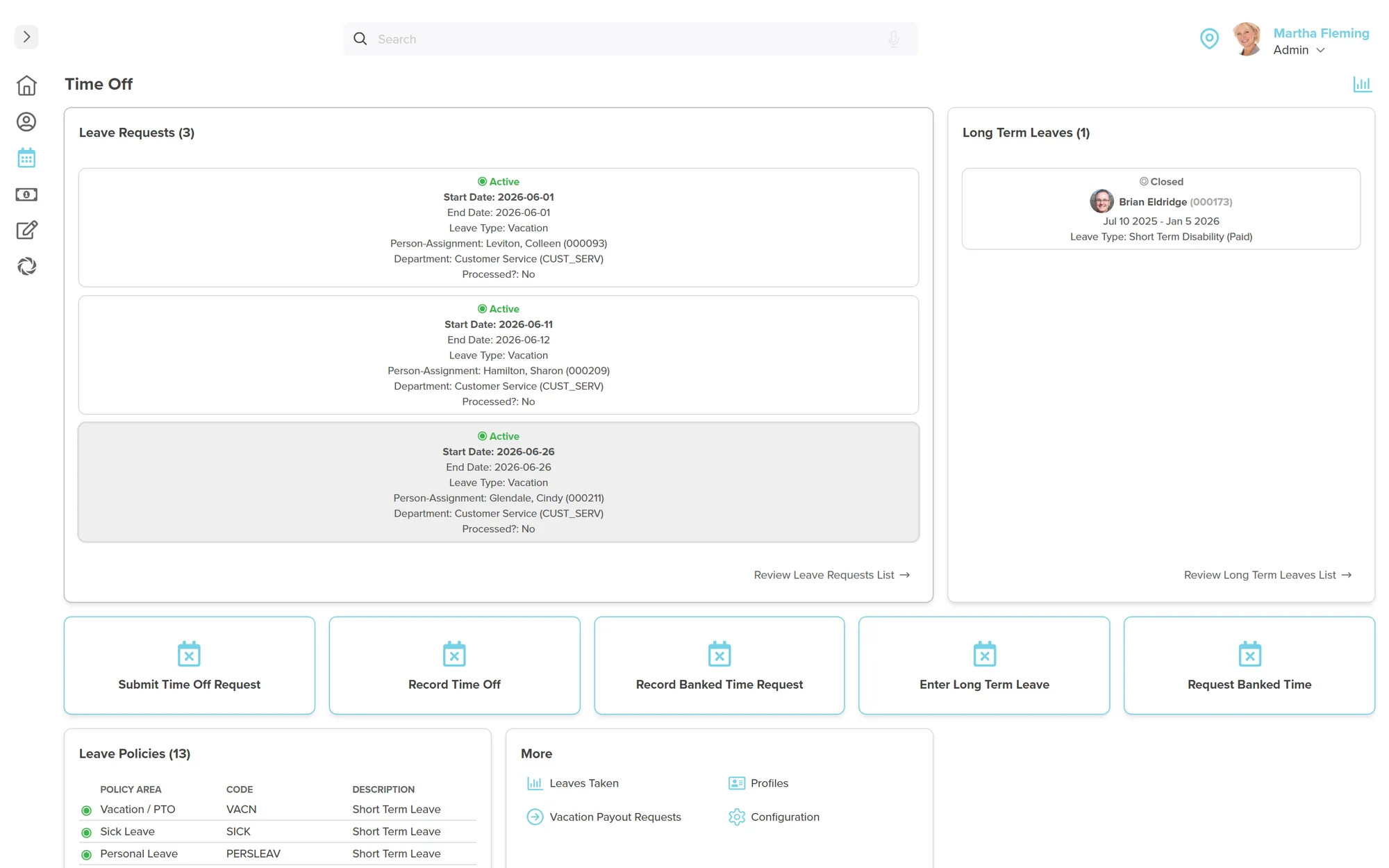
Self-service shows the leave types an employee is entitled to and the corresponding balances. Remaining reflects processed activity and excludes Booked future leave.
Employees submit a request and Workzoom routes it to the manager for approval.
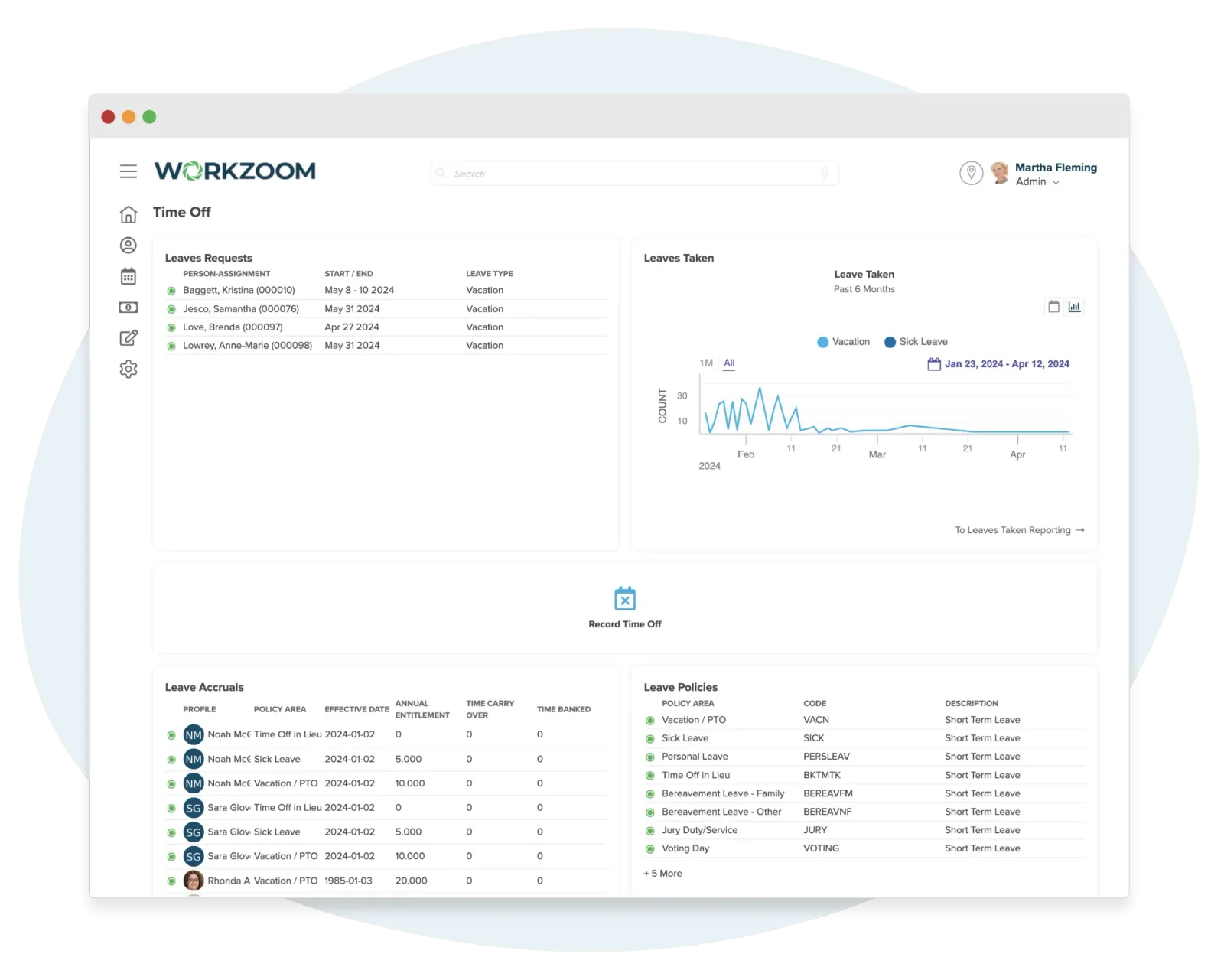
The manager can review the requestor, duration, reason, balance, team coverage and qualified substitutes before deciding. That context supports a deliberate approval rather than checking a balance in isolation.
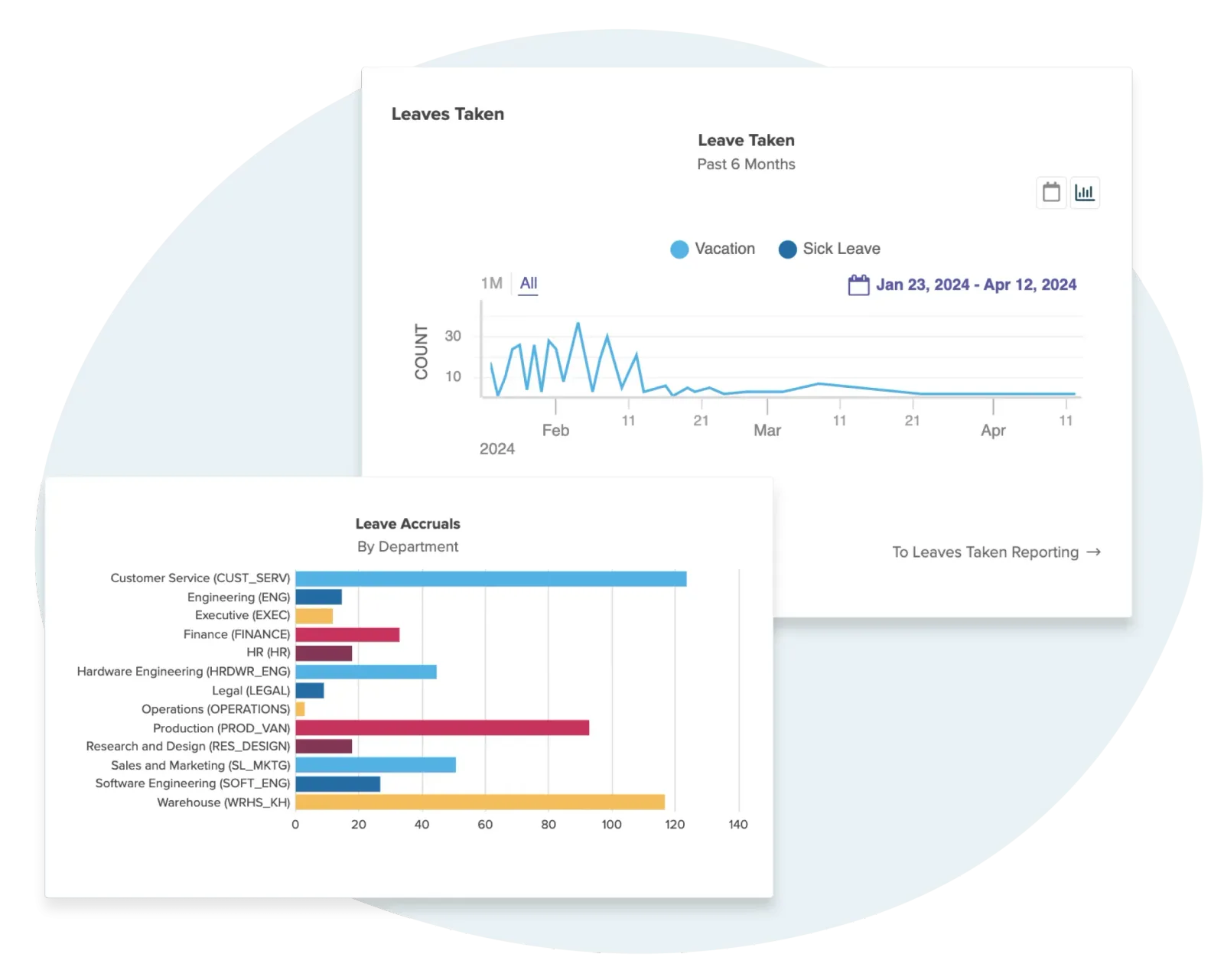
Approved leave connects to payroll-linked activity. Paid or unpaid treatment depends on the policy, employee setup and processing stage; approval is not an immediate salary deduction.
Review late or retroactive approvals with the payroll administrator, and check balances after processing is complete.
Where scheduling is enabled, approved full-day leave removes scheduled start and end times and creates a vacancy. Partial-day leave adjusts the schedule without removing the full scheduled task.
A manager reviews qualified workers and assigns the replacement.
Each requirement below is set up for your employee groups. Your team confirms which rules apply.
Source: Ontario ESA, vacation pay
Source: Ontario ESA, public holidays
Four steps. One system. No spreadsheet reconciliation.
Validate paid or unpaid treatment and the configured calculation before closing the run.
Remaining reflects processed activity once the related pay run is fully processed and closed.
Proof
Real teams. Real payroll runs. Hours back, every cycle. View all case studies

Before Workzoom, we were buried in spreadsheets. Now HR is so much simpler. We spend less time on admin and more time supporting our staff and residents every single day.


We would not be able to hire the way we do with the same resources. It has kept our headcount consistent without growing it, saving us time and money every single cycle.


Switching to Workzoom made managing payroll and timekeeping so much easier. We processed our first payroll faster than we expected and now feel far more confident in everything we do.
The story
The story
A Canadian employer with staff in more than one province may have different vacation, public holiday and leave obligations by jurisdiction and employee group. Vacation time and vacation pay are separate entitlements. Ontario recognizes nine public holidays under its Employment Standards Act; eligibility and pay calculations still depend on the employee's circumstances and the applicable rules.
Evaluate leave management software with your actual leave types, accrual rules and carry-over limits. Workzoom configures these by policy; HR confirms the applicable jurisdiction and eligibility. Future approved leave appears as Booked, separate from the processed Remaining balance, which settles after the related pay run closes. With Workzoom Payroll, the team validates pay calculations before approval.
The story
Outside Quebec, federal Employment Insurance can provide income replacement during maternity and parental leave, separate from job-protected leave under the applicable employment standards. One parent can receive up to 15 weeks of maternity benefit followed by up to 35 weeks of standard or 61 weeks of extended parental benefit, for 50 or 76 weeks combined. Quebec residents use QPIP instead. Workzoom does not process the benefit claim; the employee applies through the applicable program.
Workzoom keeps leave type, dates and return date on the employee record HR and payroll use. Outside Quebec, the employee applies for EI benefits through Service Canada; Quebec residents use QPIP. The team should confirm job-protected leave, benefits continuation, any top-up policy and return-to-work steps under the applicable jurisdiction and employment terms.
The story
Time-off requests are among the highest-volume HR transactions in most organizations. Silvera for Seniors, a Calgary senior-care organization with 400 employees across 36 buildings, ran leave management through paper forms before moving to Workzoom. Leave-balance questions had been its highest category of HR inquiries. After the switch, employees check their own balance and submit requests through self-service, and Workzoom's Canadian payroll engine handles CPP, EI and CRA T4 reporting on the same platform.
Silvera's result is a published customer outcome, not a guaranteed saving for every organization. Evaluate the leave types, accrual rules and approval chain that match your own policy before treating any customer's result as a benchmark.
Canada pricing
250 employees · HR · CA$4 per employee, per suite
No initial setup fees, no long-term contract. Implementation, migration, and training included.
Ready to run Canada time off?
Explore your suite options, pricing and fit in a 15 to 60 minute working session. For organizations with 50 or more employees. See our minimums.