 Canada
 United States
 Bahamas
 Jamaica
 Trinidad & Tobago
 Antigua & Barbuda
 Barbados
 Anguilla
Switch from ADP: The Contract Clause That Traps You

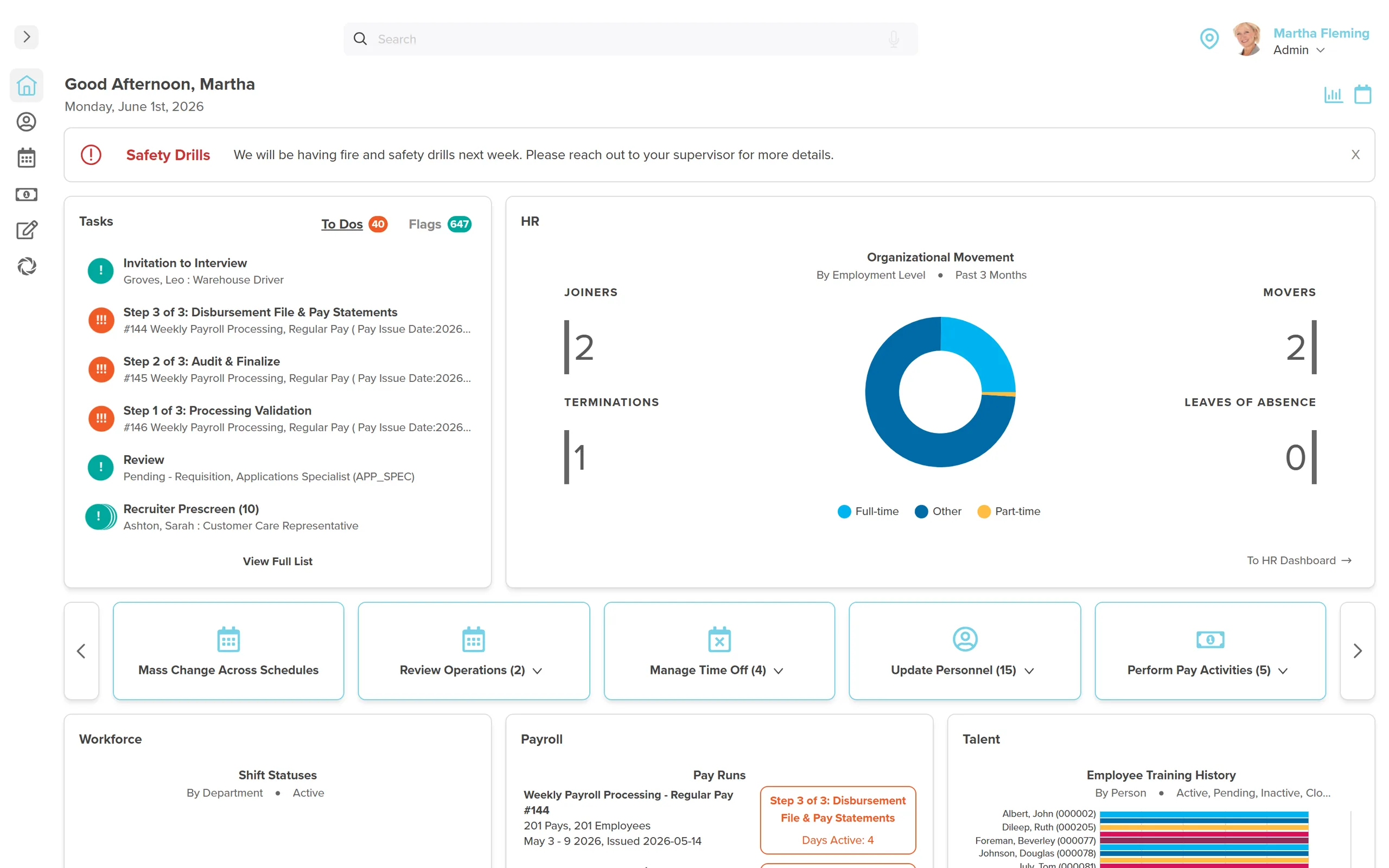
To switch from ADP, start by reading your Master Services Agreement for the cancellation notice window (typically 60 to 90 days before renewal). Export all employee data, year-to-date payroll figures, tax documents, and benefits records before submitting written cancellation. Choose your replacement, run one parallel payroll cycle to verify YTD balances, then cut over. Budget 8 to 12 weeks. January 1 is the cleanest start date, but mid-year switches work with careful balance transfers.
Most ADP exit guides miss the hard part. It's not the new software. It's the contract you signed with the old one.
Most teams treat the switch from ADP as a technical project. Export the data, load it somewhere else, run a parallel cycle. The real reason is structural. The notice window, the auto-renewal clause, and the early termination fee were all written to make leaving cost more than staying one more year. Across 25 years of payroll implementations, the pattern we see never changes: the companies that leave cleanly are the ones who read the contract before they shop, not after.
You went into payroll to pay people correctly and on time, not to project-manage a vendor divorce. So this guide does the unglamorous part first. The contract, the data, the timeline. Get those three right and the software choice becomes the easy decision it should have been.
- ADP contracts typically auto-renew for 2-3 years with a 60-90 day cancellation window. Miss it and you're locked in again.
- Early termination fees average 3 months of processing costs or 50% of the remaining contract value.
- Export everything before you cancel: employee master records, YTD payroll, tax documents, benefits enrolment, and direct deposit info.
- Best time to switch is January 1 (clean YTD). Mid-year works with proper balance transfers. Budget 8-12 weeks.
- Workzoom: $4 CAD/employee/month per suite. No setup fees, no contracts, month-to-month. Live in ~30 days.
Why Companies Switch Away from ADP
You signed with ADP because they were the safe choice. 900,000 clients. Nobody gets fired for buying the market leader. But now you're getting a renewal notice with a 20% price increase, your support tickets are sitting unanswered for a week, and you're paying extra for features you thought were included. So here you are.
You're not alone. The complaints we hear from companies actively looking to leave follow the same pattern:
- Pricing that climbs at renewal with no explanation. You signed at one rate. Two years later, the renewal comes in 15-30% higher and the rep calls it a "market adjustment." No breakdown, no negotiation offered.
- Nickel-and-diming on everything. Year-end processing? Extra. Custom reports? Extra. That integration you assumed was included? Separate module, separate per-employee fee. The base price is just the beginning.
- Support roulette. Every call starts from zero. You explain your setup, get bounced between departments, and file a ticket that takes a week to resolve. Whether you get a good outcome depends entirely on who picks up.
- Multi-year contracts with auto-renewal traps. ADP locks you in for 2-3 years. The 60-90 day cancellation window is easy to miss. Miss it once and you're in for another full term. The switching cost is the product.
- Implementation fees that can exceed $80,000 before you've processed a single paycheque. Mid-market ADP implementations routinely run $20,000 to $80,000. That's a sunk cost before the software does anything for you.
If any of that sounds familiar, you're not stuck. But you do need a plan.
Understanding Your ADP Contract Terms
Before you do anything else, pull out your ADP Master Services Agreement. Read the termination section. Everything else flows from what's in that document.
Contract Length and Auto-Renewal Traps
Most ADP contracts run for 2-3 years. That's standard. What catches people is the auto-renewal clause.
ADP contracts typically auto-renew for an additional 1-2 year term unless you provide written cancellation notice 60-90 days before the renewal date. Miss that window by a single day? You just signed up for another full term. This isn't unique to ADP, but they enforce it consistently.
Find your renewal date. Put it in your calendar. Set a reminder 120 days out so you have time to evaluate alternatives before the notice window opens.
Early Termination Fees
If you're mid-contract and want out, ADP typically uses one of two penalty structures:
- Flat penalty: Roughly 3 months of your average processing fees
- Percentage of remaining value: Around 50% of whatever's left on your contract
Buyer reports suggest a 3-month penalty on a $6,000/month account equals ~$18,000; a 50%-of-remaining structure on 18 months left equals ~$54,000. The math matters. Check your specific agreement because these numbers vary by contract.
Sometimes the early termination fee is still worth paying. If your new provider saves you $4,000/month, that $18,000 penalty pays for itself in under five months. Run the numbers before you assume you're trapped.
How to Negotiate Your Exit
ADP's retention team has real authority to negotiate. They don't want to lose your account, and that gives you more room to negotiate than you think, particularly if you've been a client for 5+ years or can document support failures and billing errors.
A few things that work with ADP's retention team specifically:
- Request a fee waiver based on account history. Long-tenured clients with documented problems get better outcomes than those who just want to leave. Pull your support ticket history before you call.
- Contact them inside your cancellation window. Outside the window, they have no incentive to negotiate. Inside it, you're a flight risk they need to address.
- Get everything in writing. Verbal promises from reps mean nothing. Get the termination terms confirmed via email or an amended agreement before you sign anything with a new provider.
- Ask for the retention team directly. Your day-to-day rep cannot waive fees. Ask for their "client loyalty" or retention team from the first call.
Check your ADP contract renewal date today. Set a calendar reminder 120 days before it. That single action gives you the standing to leave on your own terms instead of getting auto-renewed into another multi-year commitment.
Your ADP Data Export Checklist
Your data belongs to you. But getting it out of ADP in a usable format takes planning. Don't cancel your ADP account until every piece of data on this list is downloaded, verified, and saved somewhere you control.
Critical Records to Download
- Employee master records: Full name, address, date of birth, SIN/SSN, hire date, job title, department, reporting structure, employment status
- Year-to-date payroll totals: Gross pay, net pay, all deduction categories, employer contributions, taxes withheld (federal, provincial/state), CPP/EI contributions (or Social Security/Medicare for US employees)
- Pay rates and salary history: Current rate, effective dates for changes, pay frequency, overtime rules
- Benefits enrolment: Current plan selections, coverage levels, dependent information, employer/employee premium splits, benefit effective dates
- Tax forms and supporting records: T4s, T4As, RL-1s (Quebec), W-2s (US), and the supporting payroll records for the required retention period. Do not limit the archive to three prior years.
- Direct deposit details: Bank institution numbers, transit numbers, account numbers for every employee
- Time-off balances: Vacation accrued, vacation taken, sick time, personal days, carryover balances
- ROE history: Records of Employment previously filed through ADP
- Garnishments and special deductions: Court-ordered deductions, union dues, RRSP contributions, custom deductions
How to Export from ADP
ADP's reporting tools can generate most of this. Log into ADP Workforce Now or RUN and use the custom report builder. Pull reports in CSV format where possible, not PDF. CSV files can be imported directly into your new provider's system. PDFs are just pictures of data.
Some specific tips:
- Payroll register reports give you the YTD totals. Run one for each pay period in the current year.
- Employee detail reports cover the master data. Include all fields, even ones you think you don't need.
- Benefits summary reports show current enrolment. Run these before your cancellation is processed because access disappears fast after termination.
- Tax document downloads are available in the Tax section. Download everything. You're legally required to retain these records.
If you're having trouble pulling data, ask ADP for a "full data extract" as part of your offboarding. They may charge for it. Pay the fee. The alternative is manually reconstructing employee records, which costs far more in time.
Leaving ADP, Step by Step
Here's the process in order. Don't skip steps. Don't rush it.
Start with the contract fine print. Find your renewal date, notice window, and termination terms. This determines your timeline for everything else.
Run the real cost comparison. Get firm pricing from 2-3 alternative providers. Include implementation fees, per-employee costs, and any module add-ons. Compare total Year 1 cost, not just monthly rates.
Choose your replacement before you give notice. Confirm your new provider's implementation timeline. You need to know exactly when they can have you live before you submit cancellation to ADP.
Export all data from ADP. Use the checklist above. Verify the exports are complete and accurate. Don't rely on a single export. Run the reports twice and compare.
Submit written cancellation to ADP. Send it via email with delivery confirmation. Include your company name, client ID, requested termination date, and a reference to your contract's cancellation clause. Keep a copy of everything.
Begin implementation with your new provider. Share the exported data. Configure pay rules, deduction codes, benefit plans, and tax settings. This is where the 8-12 week timeline lives.
Test with a shadow payroll run. Before you cut over, process one full pay cycle through your new system while ADP is still live. Compare every line: gross, net, deductions, taxes, employer contributions. Every figure should match. If something is off, find and fix it before ADP is out of the picture.
Cut over. Once parallel results match, stop processing through ADP and go live on the new system. Notify employees about the change, especially if their pay stubs will look different or come from a new portal.
Keep ADP access for 90 days post-migration. You'll need it for tax filing questions, historical report pulls, and any discrepancies that surface after the switch. Negotiate a wind-down period in your termination agreement. Don't let ADP terminate your access the day after cancellation.
Timing Your Switch
January 1 is the cleanest time to switch. New calendar year means fresh YTD balances. No mid-year tax calculations to reconcile. No partial-year T4 complications. If you can time your ADP contract end to December 31, that's the simplest path.
But mid-year switches work too. They just require more attention to detail.
If you switch mid-year, your new provider needs to load all YTD balances: gross pay, CPP/QPP contributions, EI premiums, federal and provincial taxes withheld, and any other deductions. These numbers have to be exact. A single incorrect YTD balance means wrong tax calculations for the rest of the year, and a T4 that doesn't reconcile with CRA remittance records.
Budget 8-12 weeks from the day you start evaluating alternatives to the day you process your first live payroll on the new system. That includes 2-3 weeks for vendor selection, 3-4 weeks for implementation and configuration, 1-2 weeks for parallel testing, and 1 week for cutover.
Some providers move faster. Workzoom's average implementation is about 30 days. But even with a fast provider, don't compress your evaluation phase. A bad replacement is worse than staying on ADP.
County of Renfrew, an Ontario municipal government with roughly 900 employees, onboarded 32 employees in three months with zero paper during their migration. Their payroll lead validated every configuration before go-live. That validation step is what a 30-day timeline requires from your team.
Cable Bahamas, an 850-person telecom in the Bahamas, ran their payroll on a five-day cycle before the switch. After migration, the same three-person payroll team processes payroll in a day and a half. The 70% time reduction came from clean data going in, not from the software being magic.
Tell Us What You Need to See
If you're evaluating replacements for ADP, bring your current ADP invoice to the call. We'll show you exactly what the switch looks like for your headcount. 30 minutes, real numbers, no slides.
Book a 30-Minute CallWhat Mid-Market Companies Need
Most companies that outgrow ADP Run or feel over-served by ADP Workforce Now want the same things. They're not complicated asks. The payroll industry just makes them hard to find. SHRM's research on HRIS adoption consistently shows that mid-market organizations prioritize total cost of ownership and implementation speed over feature depth.
Transparent pricing. A number per employee per month that doesn't change at renewal. No hidden fees for year-end processing, custom reports, or basic integrations. You should be able to calculate your exact annual cost in 30 seconds.
No multi-year contracts. Month-to-month means your provider has to earn your business every month. If they stop performing, you leave. That alignment of incentives is the whole point.
One data model, not four connected products. Workzoom uses effective dating and a person-position model: every HR change records when it happened and why, and payroll pulls from that same record automatically. Change an employee's rate in HR and it flows to the next pay run, no sync job, no export, no second system to update. That's the mechanism behind "one system." Not a marketing line.
Implementation that doesn't take 6 months. If a vendor needs half a year to get you live, they're either over-engineered for your needs or under-resourced for their client load. Either way, it's a red flag.
Support from people who know your account. Not a 1-800 number that routes you to whoever happens to be available. Named contacts who understand your setup and can fix issues without asking you to re-explain your configuration every time.
ADP vs Workzoom: Side-by-Side Comparison
The table below is the short version. For the fully sourced comparison, with every ADP claim footnoted to a cited source and an honest read on where ADP is stronger, see the Workzoom vs ADP comparison page.
| Dimension | ADP Workforce Now | Workzoom |
|---|---|---|
| Pricing | Custom quote only; market estimates from buyer reports range $15–30+/employee/month | $4/employee/month per suite |
| Setup fees | $20,000-$80,000 | $0 |
| Contracts | 2-3 year terms, auto-renewal | Month-to-month |
| Implementation time | 3-6 months | ~30 days |
| Canadian compliance | Native (strong heritage) | Native (built from ground up) |
| Enterprise scale | 1,000-100,000+ employees, 140+ countries | 50-5,000 employees |
| Global payroll | 140+ countries via GlobalView/Celergo | Live: Canada, US, Bahamas. Capable of handling: Jamaica, T&T, Antigua (launch 2026/2027). UK: HR-only. |
| Target size | 50-5,000+ employees | 50-5,000 employees |
| Architecture | Modular (acquired products integrated) | Single database, all-in-one |
| Support model | Tiered, call centre | Direct, named contacts |
| Data residency | US-headquartered, US data centres | 100% Canadian-owned, AWS Canada |
| Year-end processing | Additional fees common | Included |
Note: ADP pricing is based on market estimates from buyer reports and prospect conversations. ADP does not publish standard pricing. Your actual quote may vary based on modules, employee count, and negotiation.
Cost Comparison by Company Size
| Scenario | ADP Workforce Now (estimated) | Workzoom (4 suites) |
|---|---|---|
| 150 employees | ||
| Monthly cost | $2,250-$4,500/mo | $2,400/mo |
| Annual software | $27,000-$54,000 | $28,800 |
| Implementation | $20,000-$40,000 | $0 |
| Year 1 total | $47,000-$94,000 | $28,800 |
| 300 employees | ||
| Monthly cost | $4,500-$9,000/mo | $4,800/mo |
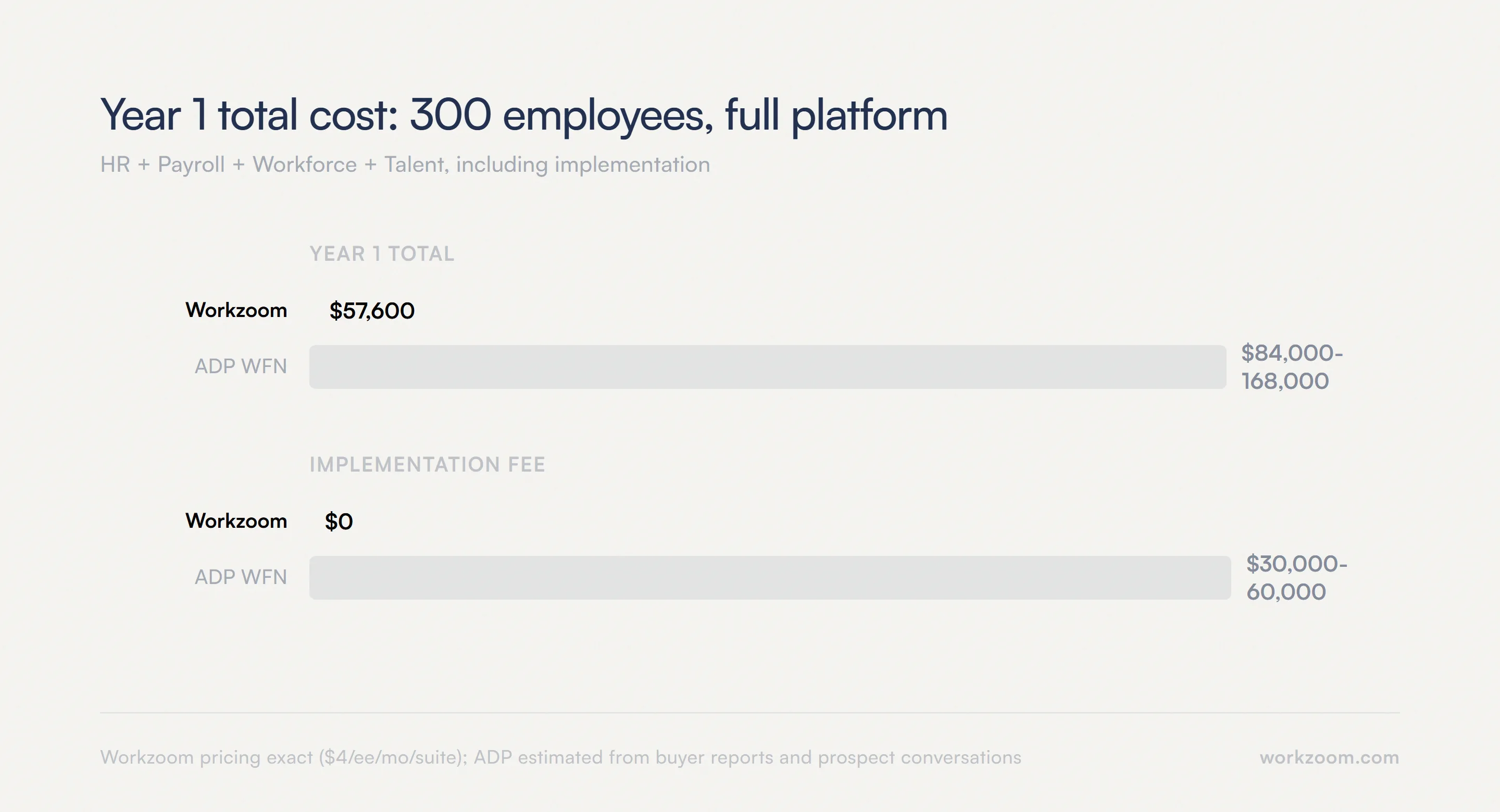
| Annual software | $54,000-$108,000 | $57,600 |
| Implementation | $30,000-$60,000 | $0 |
| Year 1 total | $84,000-$168,000 | $57,600 |
| 500 employees | ||
| Monthly cost | $7,500-$15,000/mo | $8,000/mo |
| Annual software | $90,000-$180,000 | $96,000 |
| Implementation | $40,000-$80,000 | $0 |
| Year 1 total | $130,000-$260,000 | $96,000 |
ADP estimates based on market data and buyer reports. Actual pricing varies by modules selected, contract negotiation, and company size. Workzoom pricing is published: $4 CAD/employee/month per suite, no setup fees.
Who Should Stay with ADP
Honest answer: some companies should stay.
Stay with ADP if:
- You have 5,000+ employees and need a provider with deep enterprise scale across dozens of countries
- You've built extensive custom integrations with ADP's API and partner network that would be costly to rebuild
- You need global payroll in 20+ countries from a single vendor. ADP's GlobalView and Celergo networks are hard to match at that scale.
- Your procurement team requires a publicly traded vendor with $18B+ in annual revenue for risk purposes
- You're genuinely happy with your current ADP experience and just had a momentary frustration. Switching providers is work. If your pain isn't persistent, the disruption may not be worth it.
If two or more of those apply to you, ADP might still be the right fit. There's no shame in staying with a provider that works for your situation.
But if none of those describe you, and the pricing, support, and contract issues keep coming up, it's time to look seriously at alternatives.
Switching from ADP isn't about finding a perfect provider. It's about finding the right provider for your size, budget, and complexity. For mid-market organizations that don't need global enterprise scale, there are options that cost far less and perform just as well for Canadian and Caribbean payroll.
Tell Us What You Need to See
Bring your ADP invoice. We'll do a line-by-line comparison and show you exactly what Workzoom costs for your headcount. If ADP is still the better fit, we'll tell you. 30 minutes, no pressure.
Book Your 30-Minute Comparison CallFor a broader look at the payroll switching process (not just ADP), see our complete guide to switching payroll providers. And if you're already comparing Workzoom against specific competitors, our Workzoom vs ADP comparison page covers the product differences in more detail.
See Workzoom in 30 minutes.
Real product, real questions, no slides. Starts at $4 per employee per month, CAD or USD, with $0 setup fees.
What readers ask after this post on switch from Adp.
Our clients
The teams that run their people on Workzoom.













Workzoom handles HR, payroll, workforce, and talent on one employee record. Book a 30-minute walkthrough.