 Canada
 United States
 Bahamas
 Jamaica
 Trinidad & Tobago
 Antigua & Barbuda
 Barbados
 Anguilla
Caribbean HR and Payroll

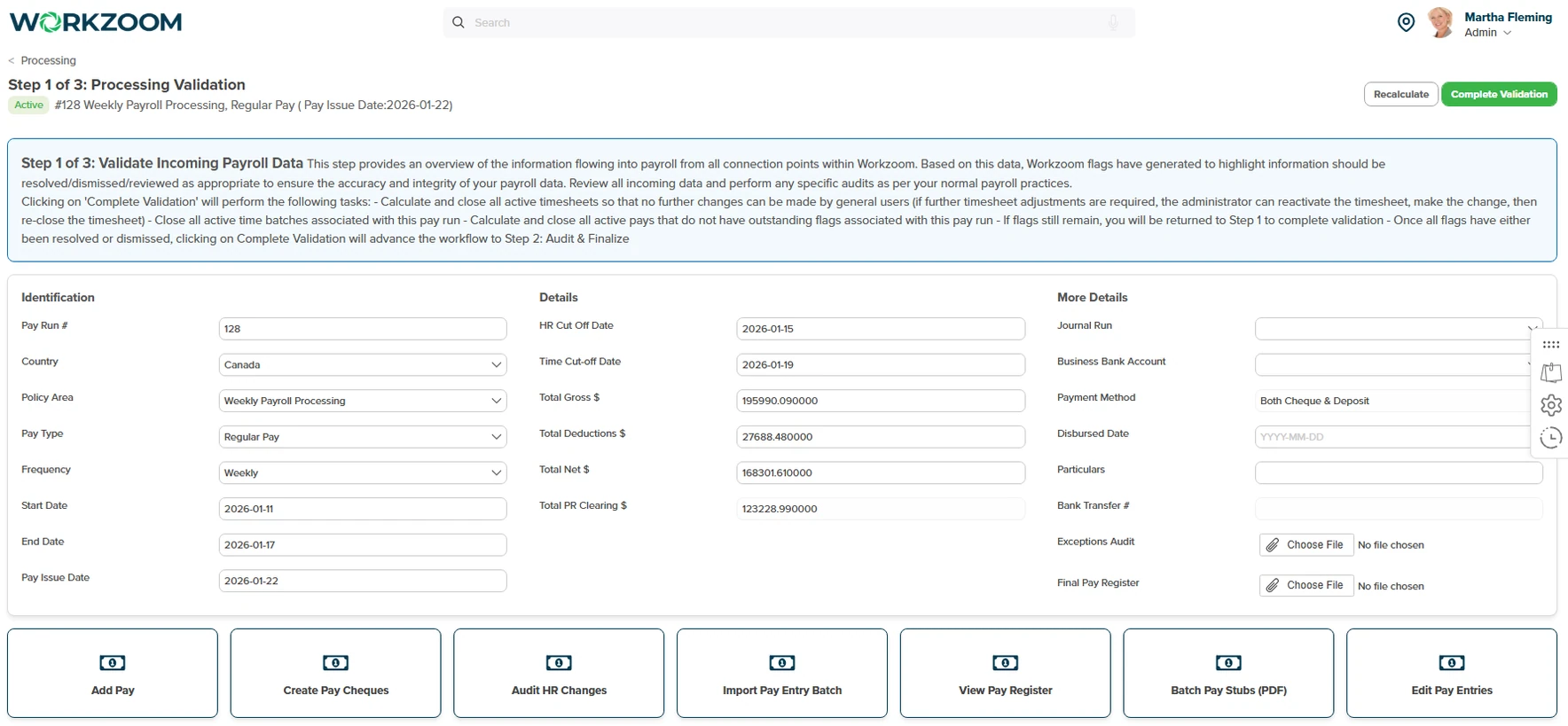
Most employers don't treat the Caribbean as five separate HR and payroll markets. They treat it as one. It is not. It is five separate statutory countries that happen to share a sea.
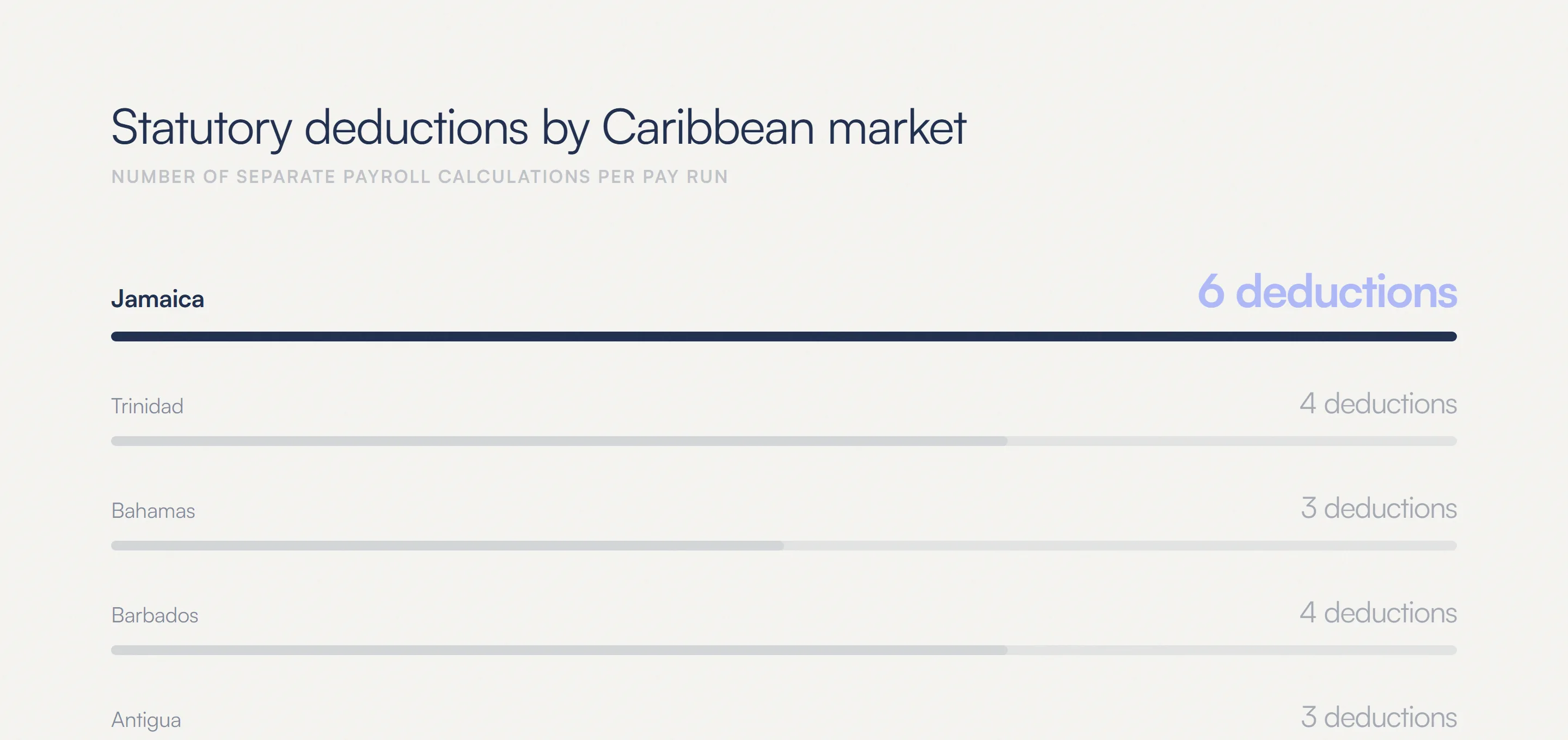
It's not a translation problem. It's a jurisdiction problem. What is fully compliant in the Bahamas is non-compliant in Jamaica, where a single pay run carries five separate deductions, and non-compliant again in Barbados, where the Employment Rights Act can order a tribunal to reinstate an employee you thought you had lawfully let go. Across the Caribbean payroll setups we see, the costly mistakes are never exotic. They are North American assumptions, at-will termination, weekly-only overtime, applied to islands that never adopted them. You went into HR to run a compliant operation, not to discover a fourth statutory body on the third pay run.
The pattern we see on discovery calls is employers managing Caribbean payroll as five separate compliance programs that happen to involve the same employees. That framing is closer to the truth than treating the region as one. The Bahamas has NIB. Jamaica layers NIS, NHT, Education Tax, HEART, and PAYE onto a single pay run. Trinidad and Tobago adds a Green Fund Levy and Health Surcharge. Barbados operates under the Employment Rights Act 2012. Antigua runs on a different NIS structure again.
Caribbean HR and payroll is not a single compliance framework. It is five distinct statutory environments operating across markets that share geography, culture, and trade relationships but have developed independent employment law, social security, and tax systems. For employers operating across the region, or expanding into any individual market, the primary risk is assuming that what works in one jurisdiction transfers to the next. It almost never does.
This guide covers what every employer needs to understand about Caribbean HR and payroll, market by market. If you are managing operations in the Bahamas, Jamaica, Trinidad and Tobago, Barbados, or Antigua and Barbuda, this is the starting point. Each country section links to the detailed guides where you can go deeper on individual obligations.
What Makes Caribbean HR Uniquely Complex
Employers entering Caribbean markets for the first time usually bring one of two assumptions: either that the region operates like the US (at-will employment, FLSA-style overtime, employer-centric termination rights) or that it operates like the UK (similar enough to adapt quickly). Both assumptions produce compliance failures.
Caribbean employment law is its own category. Several islands have employment statutes that are more protective of workers than either the US or Canada. Termination in the Bahamas requires notice or pay in lieu, plus severance for any employee with 12 months of service. Barbados's Employment Rights Act sets out redundancy procedures, fair dismissal criteria, and reinstatement powers for tribunals. Jamaica's Labour Relations and Industrial Disputes Act governs collective bargaining in a way that catches foreign-managed operations by surprise.
The statutory contribution complexity is a second layer on top. A company with 500 employees in Jamaica makes five separate statutory remittances per pay period: NIS, NHT, Education Tax, HEART (above threshold), and income tax. Each has its own rate, ceiling, remittance schedule, and penalty structure. A single missed or miscalculated remittance generates penalties that compound quickly.
The multi-island reality adds a third layer. Many Caribbean employers operate across jurisdictions, a hospitality group running resorts on three islands, a financial services firm with offices in Nassau and Bridgetown, a staffing company placing workers in both Jamaica and Trinidad. Each jurisdiction maintains its own employment records, statutory calculations, and compliance filings. Without a platform that handles each jurisdiction natively, the operational cost of multi-island payroll is significant and the compliance risk is constant.
The Caribbean is not a single labour market. The Bahamas, Jamaica, Trinidad and Tobago, Barbados, and Antigua each have distinct employment legislation, social security schemes, and tax frameworks. Compliance in one market does not imply compliance in another, and software that handles one jurisdiction's requirements natively may handle another's only through manual configuration.
What Caribbean Employers Have in Common
Despite the jurisdictional differences, Caribbean employment frameworks share a structural foundation that employers can use as a baseline before getting into country-specific detail.
Written Employment Contracts
Every Caribbean jurisdiction requires or strongly expects written terms of employment. In the Bahamas, the Employment Act 2001 requires a written statement of employment covering pay, hours, leave entitlements, and notice periods. In Barbados, the Employment Rights Act sets out the minimum written terms an employer must provide. In Jamaica, industrial relations norms and specific statutory provisions expect written contracts. The specific requirements vary, but the principle is consistent: employment relationships should be documented in writing from the start, and those documents need to reflect the local statutory minimums.
Statutory Social Security Contributions
Every Caribbean market covered in this guide has a national social insurance scheme funded by employer and employee contributions. The scheme names differ (NIB in the Bahamas, NIS in Jamaica, Trinidad, and Barbados), the rates differ, the insurable wage ceilings differ, and the benefit structures differ. What they share is that contributions are mandatory, calculated on a defined base, and subject to late payment penalties. The contribution data needs to flow accurately from payroll to statutory filings without manual extraction.
Leave Entitlements
Annual leave, sick leave, and maternity leave are statutory in every Caribbean jurisdiction. The specific entitlements vary by market and often by tenure within a market. What is consistent is that leave entitlements are not employer discretion. They are legislative minimums that must be tracked, accrued, and made available to employees on a defined schedule. Employers who treat Caribbean leave as a benefit they control rather than a statutory obligation they owe create legal exposure that shows up when staff turn over or when a tribunal hears a complaint.
Overtime and Working Hours
Standard working hours are defined by statute in every Caribbean market, and premium pay is required for hours beyond the standard. The specific thresholds and multipliers vary. The Bahamas uses both a daily trigger (8 hours) and a weekly trigger (40 hours), which differs from the purely weekly FLSA model familiar to US-based management. Work on public holidays typically attracts a higher premium than standard overtime. Employers who apply North American overtime logic to Caribbean payroll systematically underpay, and that liability accumulates over time before it surfaces in a tribunal filing or audit.
Bahamas: Employment Act 2001 and NIB
The Bahamas is the most developed Caribbean market for Workzoom clients and the one where the compliance requirements are most thoroughly documented across our supporting guides. If you are operating in the Bahamas, the statutory framework starts with the Employment Act 2001 and the National Insurance Board.
The Employment Act covers minimum wage ($260/week as of January 2023), overtime calculations (1.5x after 8 hours daily or 40 hours weekly, 2x on public holidays), leave entitlements (2 weeks vacation after 1 year, 1 week sick leave, 13 weeks maternity after 12 months' service), notice periods by tenure, and severance formulas. Non-managerial employees with 12+ months of service receive 2 weeks' pay per year of service on termination, capped at 24 weeks. Managerial employees receive 1 month per year, capped at 48 weeks.
NIB contributions total 11.3% of insurable wages: 6.65% employer and 4.65% employee, up to the $830 weekly ceiling effective July 1, 2026. Contributions are payable by the 15th of the following month. Workzoom prepares the C10 contribution statement for the employer to review and submit. Contact NIB to confirm any overdue balance and applicable interest. Businesses and self-employed persons must register with NIB within 10 working days of commencing operations; individuals must register before or as soon as possible after starting employment.
The Industrial Tribunal actively enforces worker protections. Common sources of Tribunal cases: incorrect overtime calculations (weekly-only logic missing the daily trigger), short severance payments (using current rate rather than 12-month average), and pregnancy dismissal (no qualifying period protects pregnant employees from day one).
For multi-island operations, the Bahamas compliance framework applies uniformly across Nassau and the Family Islands, but workforce management complexity multiplies with geography. Scheduling, time tracking, and payroll for staff spread across Abaco, Eleuthera, Exuma, and other islands requires systems that can handle location-based reporting without creating separate compliance silos.
Workzoom payroll is live in the Bahamas. NIB calculations, insurable earnings tracking, and statutory file generation are native features, not manual workarounds. Workzoom prepares the file, and your team uploads the submission. Cable Bahamas (850 employees) and Island Luck (850 employees, 60+ gaming locations) both run their complete HR and payroll operations on the platform.
Detailed guides: HR and payroll guide for the Bahamas covers the full Employment Act in operational terms. The Bahamas Employment Act breaks down every section of the statute. NIB compliance in the Bahamas covers contribution mechanics and filing. Common Employment Act mistakes documents the specific patterns that generate Tribunal cases. Workforce management in the Bahamas covers scheduling and time-to-payroll integration.
Jamaica: NIS, NHT, Education Tax, HEART, and PAYE
Jamaica has one of the most complex payroll compliance environments in the region. A single pay run for a Jamaican employee involves five separate statutory calculations, and getting any one of them wrong means incorrect remittances to a different regulatory body.
The Five Statutory Deductions
NIS (National Insurance Scheme) contributions fund social security benefits including retirement, sickness, and invalidity. Both employer and employee contribute on insurable earnings up to a defined ceiling. NHT (National Housing Trust) contributions build the funding pool for government-subsidized housing loans. Employees can access their accumulated NHT credits for home purchase. Both employer and employee contribute. Education Tax funds public education and is applied to gross emoluments for both employer and employee. The HEART levy (Human Employment and Resource Training) is an employer-only contribution that applies to employers with payrolls above a defined threshold and funds workforce development programs. PAYE (Pay As You Earn) is income tax withheld at source, calculated against the employee's annual income tax threshold and applied marginal rate.
Every one of these has its own contribution rate, its own insurable or taxable base, its own ceiling (or absence of ceiling), and its own remittance schedule. A payroll system that handles Jamaica compliantly is doing five separate regulatory calculations on every employee, every pay period. A generic international platform handles PAYE. The other four typically become a manual spreadsheet operation.
Employment Law Framework
Jamaica's employment law combines the Employment (Termination and Redundancy Payments) Act, the Minimum Wage Act, the Maternity Leave Act, and the Labour Relations and Industrial Disputes Act, among others. The minimum wage is set by the National Minimum Wage Order and reviewed periodically. Redundancy payments are calculated on a defined formula based on years of service. The Labour Relations and Industrial Disputes Act governs industrial action and collective bargaining in a way that requires careful management in unionized environments, common in large hospitality and public sector operations.
Workzoom's Jamaica Coverage
Workzoom is capable of handling Jamaica payroll. HR, Workforce, and Talent are available today for Jamaican employers. If Jamaica payroll is part of your evaluation, raise it during your walkthrough and we will give you an honest picture of the timeline and fit.
Detailed guides: HR and payroll guide for Jamaica covers the full statutory environment. Jamaica payroll compliance goes deep on the five-deduction structure. Employee benefits in Jamaica covers statutory and supplemental benefits.
Trinidad and Tobago: NIS, Health Surcharge, PAYE, and the Green Fund
Trinidad and Tobago has a mature statutory employment framework administered by multiple regulatory bodies. The National Insurance Board of Trinidad and Tobago oversees NIS contributions, the Board of Inland Revenue handles PAYE, and the Green Fund Levy sits in a separate category as an environmental contribution based on gross revenue.
Statutory Contribution Structure
NIS contributions in Trinidad and Tobago apply to insurable earnings for both employer and employee. The rates and insurable earnings ceiling are set by the National Insurance Board and reviewed periodically. The Health Surcharge is a statutory deduction on employment income that funds public health services. Employees are deducted at a flat weekly rate based on their income band. Employers remit the collected amounts alongside NIS contributions. PAYE is income tax withheld at source, calculated against the personal income tax schedule. Trinidad and Tobago has a tax-free allowance structure, and the PAYE calculation must reflect the employee's chargeable income net of their annual exemptions.
The Green Fund Levy is applied to gross revenue and is technically a business contribution rather than a payroll deduction, but it requires tracking and remittance that touches the finance and HR function in most organizations. Companies above the revenue threshold remit quarterly.
Employment Law in T&T
The Retrenchment and Severance Benefits Act governs termination and redundancy payments. The Industrial Relations Act covers collective bargaining. The Maternity Protection Act provides for maternity leave. Trinidad and Tobago's statutory framework is extensive, and employers with North American management experience regularly underestimate the retrenchment payment obligations on large-scale workforce changes.
Workzoom's T&T Coverage
Workzoom is capable of handling Trinidad and Tobago payroll. HR, Workforce, and Talent are available today. Mention T&T payroll at your walkthrough and we will walk through the specifics.
Detailed guides: HR and payroll in Trinidad and Tobago covers the full compliance environment. HR software for T&T examines platform requirements for the market.
Barbados: Employment Rights Act 2012 and NIS
Barbados has one of the region's more structured employment law frameworks in the Employment Rights Act 2012, which codified worker rights around dismissal, redundancy, notice, and leave entitlements in a single statute. For employers accustomed to less codified frameworks, the ERA's specificity is initially surprising. Termination must follow a fair procedure. Redundancy payments follow a defined formula. Reinstatement is an available remedy for Employment Rights Tribunals.
Statutory Contributions
National Insurance contributions in Barbados are administered by the National Insurance Department and apply to insurable earnings for both employer and employee. The rates and contribution ceilings are reviewed periodically. PAYE is administered by the Barbados Revenue Authority. Employers withhold income tax at source and remit monthly. The BRA has been active in enforcement, and remittance delays generate penalties that accumulate quickly.
Employment Rights Act Compliance in Practice
The ERA's fair dismissal requirements mean that termination decisions require documented grounds, an opportunity for the employee to respond, and a decision-making process that a tribunal would find reasonable. Employers who terminate for performance without documented performance management history create unfair dismissal exposure. Employers who conduct mass redundancies without following the prescribed notification and selection process create wrongful redundancy claims. The ERA is detailed enough that Barbadian employment lawyers recommend external HR audit before any significant workforce restructuring.
Workzoom's Barbados Coverage
Workzoom is capable of handling Barbados payroll. HR, Workforce, and Talent are available for Barbadian employers today. The platform handles the HR workflow requirements that ERA compliance demands: documented performance management, leave tracking, contract management, and the organizational records that support a compliant termination process.
Detailed guide: HR software for Barbados covers platform requirements in the Barbadian market.
Antigua and Barbuda: HR, Workforce, and Talent
Antigua and Barbuda operates under the Antigua and Barbuda Labour Code, which governs employment contracts, minimum wage, leave entitlements, termination, and redundancy. The market has a significant hospitality sector and a growing financial services presence. NIS contributions are administered by the Medical Benefits Scheme and the Social Security Board.
Workzoom's HR, Workforce, and Talent modules are available for Antigua and Barbuda employers today. For employers evaluating Workzoom for Antigua, that covers people management, scheduling, time tracking, and talent. Antigua payroll runs through your existing provider for now, so plan to keep that piece where it is.
Detailed guide: People management in Antigua and Barbuda covers the Labour Code framework and HR platform requirements for the market.
Workzoom's Caribbean coverage varies by market. Bahamas payroll is fully operational today, including NIB calculations, Employment Act compliance, and multi-island workforce management. The other markets follow a different model: Jamaica, Trinidad and Tobago, and Barbados all have HR, Workforce, and Talent available now. Payroll support for those markets is in development; contact us about your timelines. Antigua has HR, Workforce, and Talent. The framing matters: we are not selling a roadmap. We are telling you exactly what is live today so you can make an honest evaluation.
What to Look for in HR Software for Caribbean Operations
Caribbean employers evaluating HR and payroll software make a common mistake: they assess platforms on features and pricing without asking whether the platform's compliance logic was actually built for the region. "International payroll" as a feature on a North American platform almost always means multi-currency processing. It does not mean NIB insurable earnings ceilings are tracked natively, or that NHT sits alongside Education Tax as a distinct layer on every Jamaican pay run, or that the Barbados ERA's fair procedure requirements are built into the termination workflow.
Native Compliance vs. Manual Configuration
The right question is not "can this platform handle my jurisdiction" but "how does it handle my jurisdiction." If the answer is through custom fields that your team configures and maintains, you have moved the compliance responsibility from the vendor to your payroll team. When Jamaica revises NHT rates, does the update come from the software vendor or from an email asking you to update your custom field? That answer determines whether you have compliance infrastructure or compliance risk dressed up as software.
Multi-Country in a Single System
Employers operating across multiple Caribbean islands need a single platform that maintains separate compliance configurations per jurisdiction while providing unified workforce visibility. The alternative, separate platforms per island, creates exactly the kind of data fragmentation that produces reporting errors, cross-jurisdictional compliance gaps, and operational overhead. A regional hospitality group running resorts in the Bahamas, Jamaica, and Barbados should see their full headcount, leave liability, and payroll in one dashboard, even when the underlying compliance calculations are running three separate statutory schemes.
Statutory Update Ownership
Caribbean governments review contribution rates, minimum wages, and tax thresholds periodically. NIB rates have changed. Jamaican NHT thresholds have been revised. The question for any software evaluation is who owns the update when the rate changes. If the answer is your team, you have taken on a compliance maintenance function that belongs in the platform. If the answer is the vendor, you have compliance infrastructure.
Termination and Leave Workflows
Payroll is the most visible compliance requirement, but HR workflow compliance matters equally. The Bahamas Employment Act's specific notice periods and severance formulas need to be encoded in termination workflows, not left to manual calculation. Barbados's ERA fair procedure requirement needs a documented process built into the platform's performance and disciplinary tools. Leave entitlements that tier by tenure need to accrue correctly and be available for employee and manager self-service without payroll team intervention on every request.
The best HR software for Caribbean employers guide goes deeper on platform evaluation criteria, feature requirements by employer type, and what live Caribbean deployments actually look like.
How Caribbean Employers Use Workzoom in Practice
The most useful evidence for any software claim is what live clients actually experience. Two Bahamian case studies illustrate what Caribbean compliance infrastructure looks like when it is working.
Cable Bahamas: 850 Employees, 70% Faster Payroll
Cable Bahamas is one of the Bahamas' largest employers, with approximately 850 employees across telecom and media operations. Before Workzoom, their payroll process was a combination of legacy software and manual reconciliation. NIB contributions required manual extraction and cross-referencing. Overtime calculations for shift workers were verified manually against time records. Compliance reporting was a dedicated manual function.
After implementation, payroll processing time dropped by 70%. NIB calculations run natively within the payroll engine, pulling from time and attendance data without manual intervention. The compliance team shifted from processing to reviewing. The operational gain came from eliminating the manual steps between time data and payroll output, the same steps where Caribbean employers typically accumulate compliance errors.
Island Luck: 60+ Locations, 8 Payrolls Per Week
Island Luck operates 60+ gaming locations across the Bahamas with approximately 850 employees. The operational reality of a distributed workforce, multiple locations, different staffing levels, and 8 separate payroll runs per week, required infrastructure rather than process. Tracking hours, calculating overtime, managing leave, and running NIB contributions across dozens of locations through manual or semi-manual systems creates compounding errors at scale.
Workzoom handles the full people operation for Island Luck: scheduling across all locations, time and attendance capture, leave management, and payroll with NIB calculations automated throughout. The scale of 8 payrolls per week is operationally feasible because the compliance logic is encoded in the platform rather than in someone's head.
Managing Caribbean HR and payroll across multiple markets or locations?
Workzoom is built for Caribbean employers who need compliance infrastructure, not compliance workarounds. Bahamas payroll is fully live, including NIB and Employment Act compliance. For Jamaica, T&T, and Barbados: HR, Workforce, and Talent are available now. The payroll engine is capable of handling those markets' statutory stacks; contact us about payroll and your timelines. $4/employee/month per suite, no setup fees, no annual contracts. One platform, one conversation.
Book a WalkthroughCaribbean HR and Payroll Series: All Guides
This hub post is part of Workzoom's Caribbean HR and Payroll series. Each country has its own detailed guide plus specialist posts on specific compliance topics. Start with the hub (you are here), then go deeper on the markets that are relevant to your operations.
- Bahamas: HR and payroll guide for the Bahamas | Bahamas Employment Act | NIB compliance in the Bahamas | Common Employment Act mistakes | Workforce management in the Bahamas
- Jamaica: HR and payroll guide for Jamaica | Jamaica payroll compliance | Employee benefits in Jamaica
- Trinidad and Tobago: HR and payroll in Trinidad and Tobago | HR software for T&T
- Barbados: HR and payroll guide for Barbados | HR software for Barbados
- Antigua and Barbuda: People management in Antigua and Barbuda
- Regional overview: Best HR software for Caribbean employers
See Workzoom in 30 minutes.
Real product, real questions, no slides. Starts at $4 per employee per month, CAD or USD, with $0 setup fees.
What readers ask after this post on Caribbean HR and payroll.
Our clients
The teams that run their people on Workzoom.












Workzoom handles HR, payroll, workforce, and talent on one employee record. Book a 30-minute walkthrough.